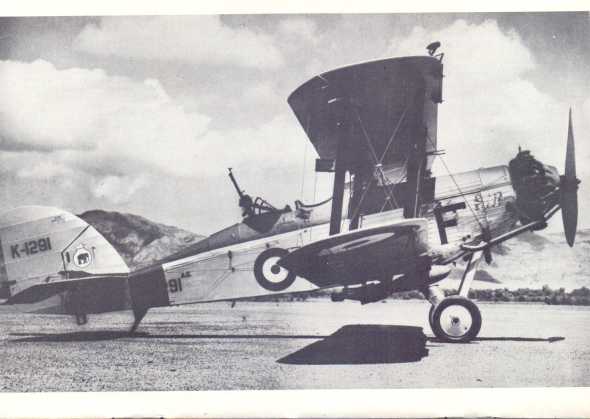

The Indian Air Force came into existence on 1st April 1933, largely as a result of insistent public demand which precipitated in the Indian Sandhurst Committee’s recommendation that Indians be made eligible for employment as Kings Commissioned officers in the Air Arm of the Army in India. Six Indians had been selected for training at Cranwell and latterly the Army Co-operation Training School following which these officers and 19 Hawai Sephais, grouped as the nucleus of No. 1 Squadron, took charge of four Wapiti HAs at Drigh Road. The `Wop’ army co-operation biplane, first introduced to the North-West Frontier of India in October 1928 with R.A.F. Nos. 11 and 39 Squadrons, also equipped all eight R.A.F. squadrons stationed in India at the time and was a welcome change from the ancient Bristol F2Bs and D.H.9As. The Wapiti’s fourteen-year service was a valuable contribution to the R.A.F’s record in India and this aircraft type was to become the foundation upon which were built the present-day Air Forces in the Sub-Continent.
`A’ flight remained in training at Drigh Road for three years, moving to Peshawar on 1st April 1936 for attachment to No. 20 Squadron R.A.F. for training in frontier operations. -`B’ Flight was formed at the same time, with one Wapiti on strength and soon got involved in co-operation training with Southern Command at Bangalore. In September 1937, the Wapitis of ‘A’ Flight proceeded to Miramshah in North Waziristan for their first tour of operations against the Bhittani tribesmen. The frontier watch-and-ward tour in company with various R.A.F. units involved either blockade, proscription or destructive air action in co-operation with the land forces and lasted till the third week of November 1937. The Flight was based at Miramshah with the aircraft staging through the forward airstrips at Drazinda and Manzai, located on a bald desert plateau. The Wapiti’s conducted patrols over convoys, tactical & photographic reconnaissance, close support and bombing with 20 lb. (9 kg.) Coopers, 112 lb. (51 kg.) RLs and, occasionally, 250 lb. (114 kg.) bombs. Small-arms fire from tribesmen was encountered with some aircraft holed and force-landed, not infrequently because of engine failure owing to primitive refueling methods.
In June 1938, ‘C’ Flight was formed, moving to Ambala to join ‘B’ Flight while ‘A’ Flight, with three Wapitis, were deputed to Miramshah for a second tour of operations in the Mami Ragha and Lwargi Narai areas north of Razmak. In July 1938, No. 1 Squadron’s three flights came together for the first time, in Ambala, the Wapitis being distributed evenly with three aircraft per flight. ‘C’ Flight operated from Miramshah from 25th September till 18th November carrying out an average of 400 operational flying hours each month. Two Wapitis were lost through accidents but the pilots and air gunners returned to Miramshah evading the hostiles in tribal territory. ‘A’ Flight operated on the Frontier from April to June 1939, logging 403 hours of flying in May alone and evoking a tribute from Air Headquarters. On 25th June 1939, No. 1 Squadron re-equipped with the Hart (India).
With the outbreak of war in Europe, an expansion of the air service in India was planned. Owing to the great shortage of squadrons in India in 1939 and the impossibility of obtaining reinforcements, it was decided to form volunteer units for the defence of the coasts. In November 1939 five Volunteer Reserve Flights of the Indian Air Force were raised at Karachi, Bombay, Cochin, Madras and Calcutta for duties in connection with coastal defence. Composed mainly of Indians, with a few British businessmen having flying experience, the IAFVR was recruited from the ports and began training at Risalpur on November 11th 1939. The Royal Air Force’s No. 27 Squadron headquarters, flying Wapitis, were moved to Risalpur and transformed into a Flying Training School. Early in 1940 the IAFVR continued their training on Wapitis at Ambala until the end of October when the various Coast Defence Flights were formed. No. 1 went to Madras, No. 2 was stationed at Bombay, No. 3 at Calcutta, No. 4 at Karachi and No. 5 was formed as the Cochin Flight but as the airfield at Cochin was not then ready, it operated alongside No. 4 at Karachi.
The problem of aircraft availability was mitigated by the modernisation of the regular R.A.F. units, and except for No. 2 C.D.F., the Flights were equipped with Wapitis. In these obsolete aircraft, in all weather, the patrols were flown almost unceasingly along India’s 3000 miles of coastline; the flights were not supposed to be a striking force but their job was to patrol the coastwise shipping lanes and escort the great convoys of troops and supplies in and out of the harbours to the limits of their flying range.
The acute shortage of aircraft and spares during the first two war years meant No. 1 Squadron reverting to the Wapiti, some 71 numbers of this old workhorse having remained airworthy with the R.A.F. in India on 3rd September 1939. Two flights of No. 1 Squadron went back to Wapitis, “C” Flight being posted to Fort Sandeman in June 1940 as the first fully Indianised unit of the I.A.F. while “B” Flight proceeded to Miramshah, taking over from No.28 Squadron, R.A.F. From July to September 1940, the Wapitis operated in the Daur Valley in support of the land forces, one crew dropping ammunition in their socks onto a beseiged picquet. Throughout the summer of 1941, they carried out operations in the Tochi Valley until No. 1 Squadron was re-equipped with the Lysander in August 1941. Meanwhile, at the end of March 1941, Nos. 1 and 3 Coast Defence Flights returned their Wapitis which were used to form No. 2 Squadron at Peshawar on 1st April. Wapitis of No. 2 Squadron were soon operating from Miramshah alongside No. 1 Squadron, assisting the Razmak and Bannu brigades in operations against hostile tribesmen in the hills surrounding the Tochi Valley. On 7th July, a day of maximum effort, the Wapitis carried out 55 flying hours, strafing and bombing, losing one aircraft in the entire tour.
In September 1941, No. 2 Squadron re-equipped with the Audax and its Wapitis were returned to the Coast Defence Flights. No. 4 C.D.F., with four Wapitis and two Audaxes arrived at Moulmein from Karachi at the end of December 1941 during the early stages of the Burma Campaign. Unfortunately, Japanese bombers destroyed four of the six aircraft at the airfield but the survivors carried out much valuable work shepherding ships entering and leaving ports, the sight of these elderly biplanes on anti-submarine patrol bearing some comfort to convoys. No. 6 (Vizakapatnam) Flight was raised in March 1942 with two Wapitis: the flight was first to report position of the Japanese fleet consisting of one battleship, one aircraft carrier, a cruiser, and two destroyers off the east coast of India in April 1942. One Wapiti, tracking hostile craft, ran out of fuel and landed on the sea, its crew being rescued by a merchant vessel.
Some Wapitis were passed on to Anti-Aircraft Co-operation. Flights and continued their service for some years after the C.D.F’s were disbanded, late in 1942.
Notes:
Stemming from the 1927 general-purpose aeroplane requirement of Air Ministry Specification 26/27, the Westland Wapiti was a compromise for it utilized certain components, including the wings and tail surfaces, of the D. H.9A with which the RAF’s reserve inventory was well stocked. Accepted for production in 1928, the major mark of the Wapiti to enter R.A.F, service was the Mk.IIA (432 built) which, with an all-metal construction and all-round improvement in performance meaning a safer and confident start to any operational flight, was a welcome change from the ancient ‘Ninaks’ and ‘Brisfits’ on the NWFP. The Wapiti IIA was powered by a 550 h.p. Jupiter VIII engine.
| Country of Origin | United Kingdom |
| Armament | One fixed Vickers machine gun mounted on portside of fuselage and synchronized to fire between propeller blades. A Lewis machine gun on a scraff ring-mounting in the rear cockpit. 20 lb. (9 kg.), 112 lb. (51 kg.) or 250 lb. (114 kg.) bombs till a total of 580 lb. (263 kg.) |
| Performance | Max. speed 140 m.p.h. (225 km/hr) |
| Service ceiling 20,600 ft. (6,280 m.) | |
| Combat range 360 miles (580 km.) | |
| Weights | Max. take off 5,400 lb. (2,450 kg.) |
| Dimensions | Span 46 ft. 5 in. (14.15 m.) |
| Length 32 ft. 6 in. (9.91 m.) | |
| Height 11 ft. 10 in. (3.61 m.) | |