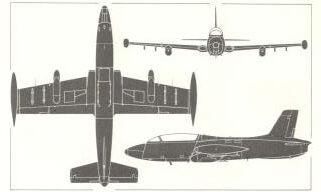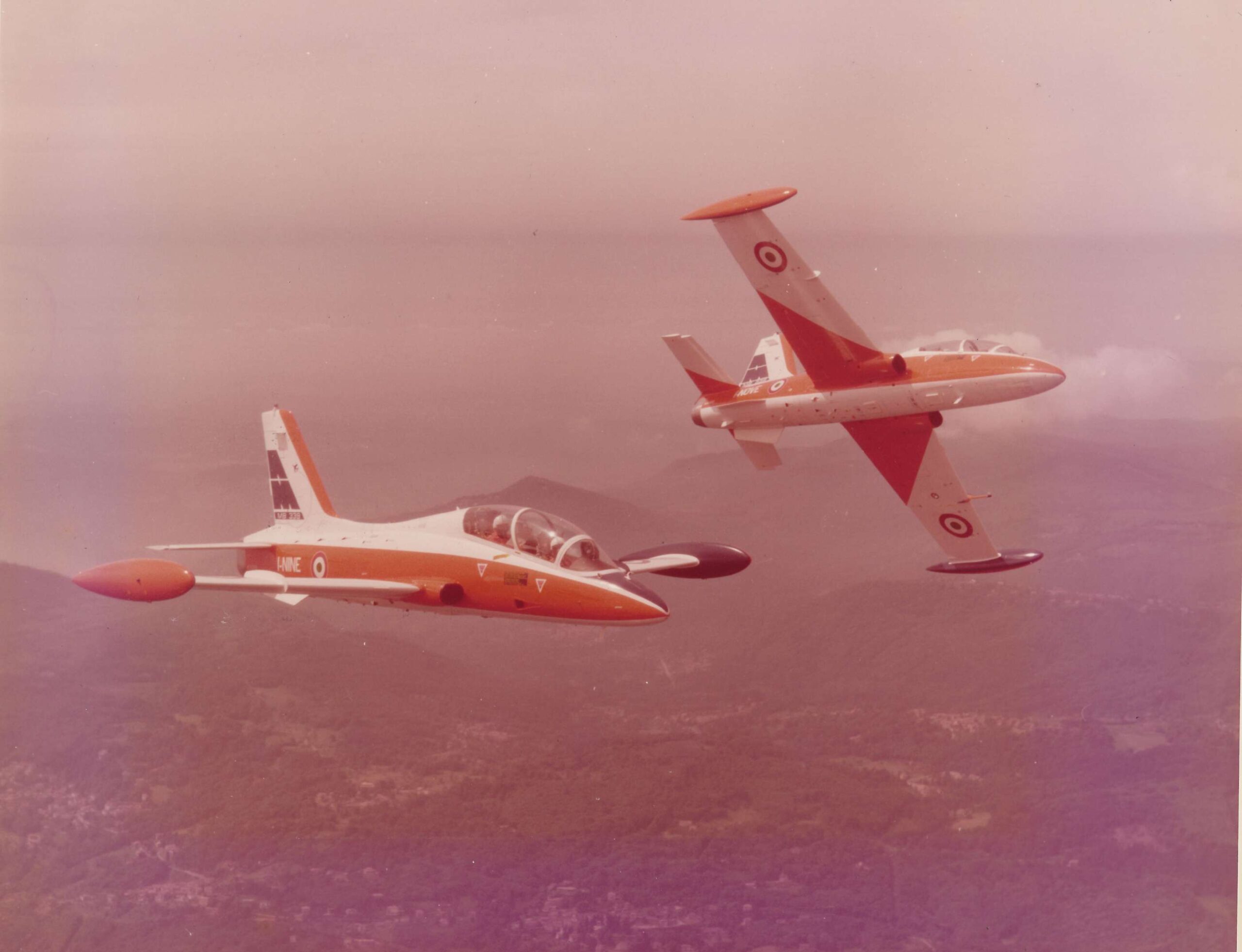
The MB-326 was developed by the Italian concern of Aermacchi to fulfill an Italian Air Force requirement covering an Advanced Jet Trainer (AJT) with a limited light strike capability. The aircraft was flown, for the first time, in December of 1957 and formally introduced into service in February of 1962. The type flew with the high profile air services of Australia, Brazil, Italy, and South Africa as well as many lesser organizations. It was during the post-World War 2 (1939-1945) period that the turbojet age had arrived and this naturally pushed all of the primary defense powerhouses of the world – including a rebuilding Italy – to invest mightily in research and development of all-new flying forms to overtake the piston-driven types of the wartime era. Macchi began work on the MB-326 as a private venture effort in which the new aircraft was to be powered by the popular and proven British Armstrong Siddeley (later under the Rolls-Royce brand label) “Viper” turbojet engine (“Viper 8”). Macchi beat out a competing design in FIAT (the G.80) as the Italian government authorized three prototypes – two flyable and one single static test bed. The former became “MM.571” and “MM.572”, respectively, during development. Throughout its developmental cycle, the MB-326 was modified and refined as needed, resulting in a substantially different aircraft than the one originally envisioned. Before the end of 1958, the Italian government fully committed to the type and ordered it into serial production. The initial batch of aircraft constituted 15 pre-series models to be followed by 50 production-quality forms. In 1960, a further 100 aircraft were added to the stable. Deliveries began in 1962. The primary customer was the Italian Air Force who began operations with the type through the base MB-326 entry numbering the two prototypes and 125 follow-on “production training” models. The MB-326A was a proposed, lightly-armed version that was not evolved. The MB-326B were eight export minded airframes delivered to customer Tunisia. Then followed the MB-326D of which four were completed and sent to Alitalia. The Italian Air Force then introduced the MB-326E, six twin-seat trainers capable of light armament.
| Country of origin | Italy |
| Performance | Max Speed: 553 mph (860 kph / 481 kts) |
| Ceiling: 41,010 ft (12,500 m / 8 mi) | |
| Range: 677 m (1,090 km / 2019 nm) | |
| Rate of Climb: 6,500 ft / min (1,981 m / min). | |
| Dimensions | Length: 35.0ft (10.67m) |
| Width/Span: 35.6 ft (10.85 m) | |
| Height: 12.2 ft (3.72m) | |