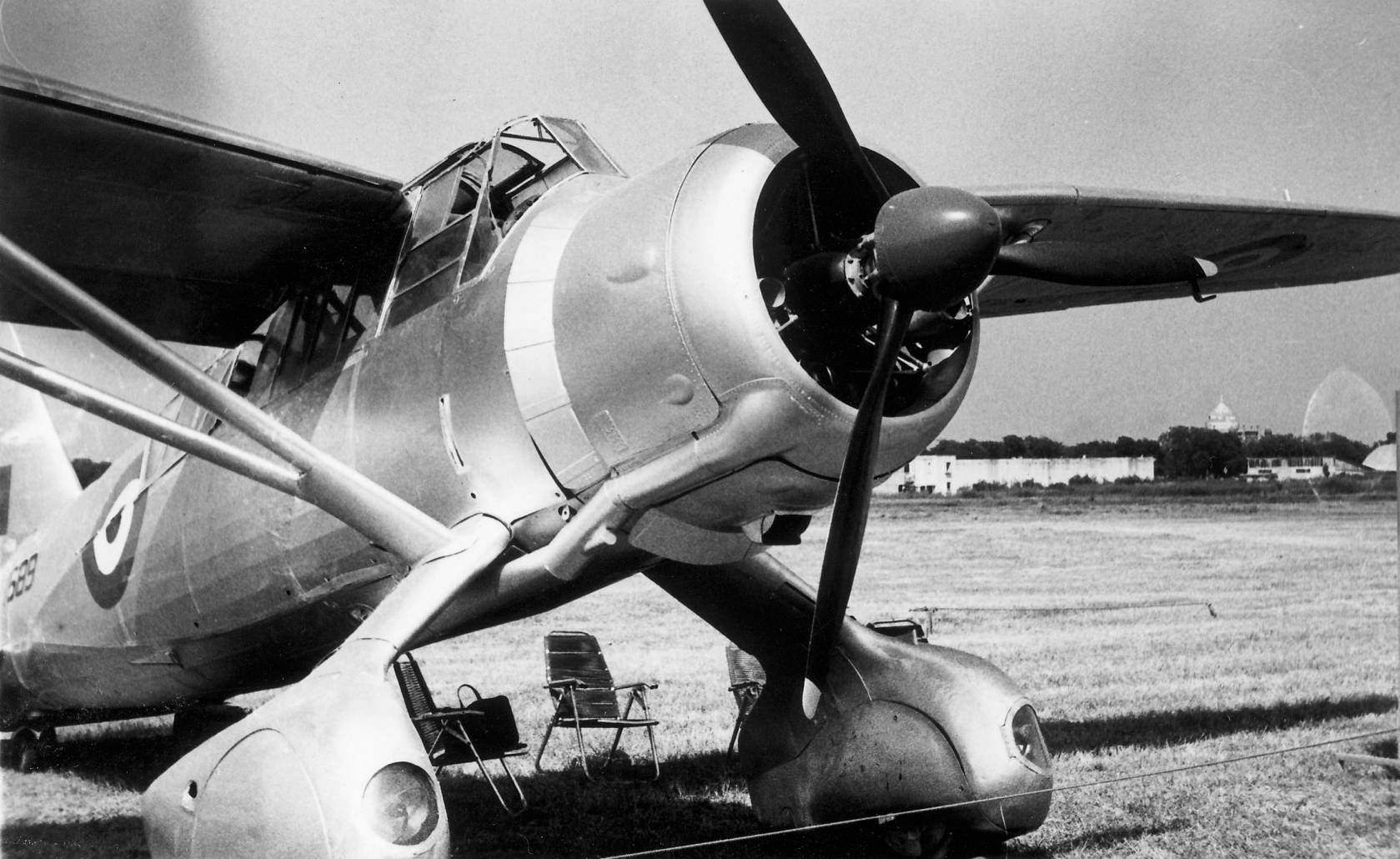
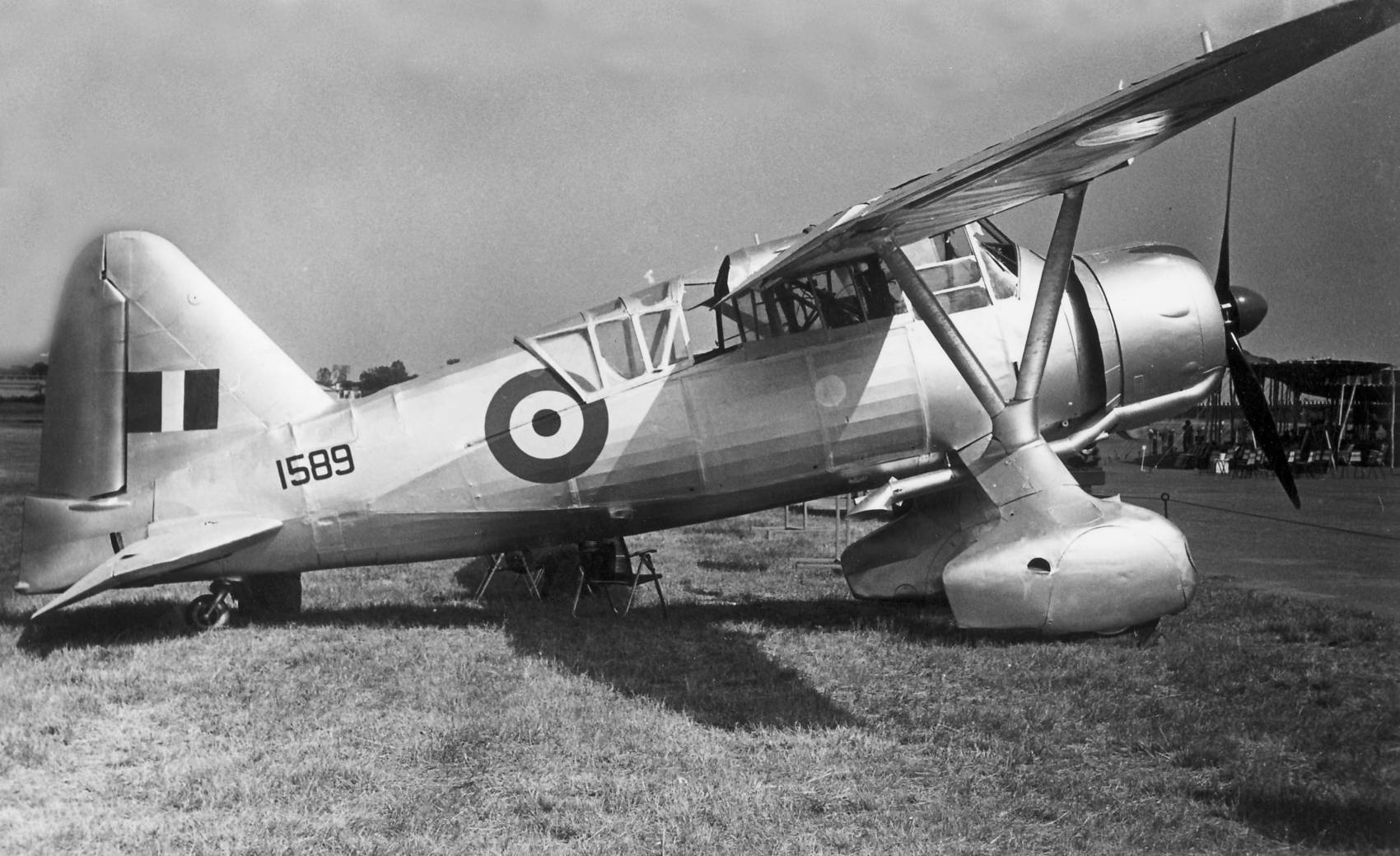
Close-support work for the army in the NWFP had been performed by “general purpose” aircraft such as the Wapiti and Hart through the thirties and when, about the middle of 1941, some Army Co-operation Lysanders were available it was decided to re-equip No. 1 Squadron with them. Notwithstanding some sceptics who doubted the young forces’ ability to manage more complicated machines, No. 1 Squadron converted to the Lysander at Drigh Road in August 1941. No. 20 Squadron R.A.F., also equipped with Lysanders, moved to Peshawar in March 1942 to form No. 152 O.T.U. for bomber conversion training. On 7th November 1941, twelve Lysanders, paid for by the citizens of Bombay, were officially presented to No. 1 Squadron at Peshawar.
Both aircrew and ground personnel were quickly operational on the Lysander and the senior NCO of the unit improvised a self-designed wooden-cum-rubber tail wheel for the Lysander which was to be of excellent value during the First Burma Campaign. No. 1 Squadron reached Toungoo in Burma on 1st February 1942 sharing the base with No. 28 Squadron R.A.F., No. 67 Squadron with Buffalos and some P-40s of the American Volunteer Group (A.V G.). No. 1 Squadron moved to Mingaladon, just outside Rangoon, on 5th February and in the second week was split up: a flight went to Lashio to support the Chinese 5th Army in North Burma, one back to Toungoo, the third remaining at Mingaladon. Moves in the fluid situation soon became rapid and pilots and their air gunners frequently did their own maintenance, operating from forward strips such as “Johnny Walker” and “John Haig”. The Lysanders acquitted themselves admirably in their self-imposed task. Although slow and lumbering, with little manoeuvrability and essentially for reconnaissance, the improvised Lysander-bomber, fitted with two 250 lb. (114 kg.) bombs, raided the main Japanese air bases at Mae-Haungsaun, Cheingmai and Chiangrai in Siam, unescorted and relying only on camouflage and low height to escape Japanese fighters, often leading Lysanders of No. 28 Squadron RAF. The lone Lysander from Toungoo carried on daily reconnaissance over the Siam border and all approaches from the Sittang river were carefully watched but time was also taken out to hit back at the Japanese airfields at Messaring and Mehongson.
The main participation by IAF Lysanders was, however, Tac/Rs and close support work for the army, this continuing till the fall of Rangoon on 7th March. On that day, two IAF volunteers flew RAF pilots from Magwe to Rangoon to fly out two abandoned Hurricanes while under hostile fire. The last six Lysanders, based at Lashio, were later committed for reconnaissance over the retreating Chinese army; on 12th March, the few remaining Lysanders were handed over to the Burmese Communication Flight, the aircrews being evacuated to India in a Flying Fortress. The fact that during the operations only one Lysander was lost to hostile action can be attributed to the skill which the pilots had acquired through flying over the rough country in the North Western frontiers of India.
No. 2 Squadron had received Lysanders by the end of 1941 and trained on anti-invasion exercises till the unit converted to the Hurricane in September 1942. The third IAF unit to be equipped with Lysanders was No. 4 Squadron which received four aircraft as its initial equipment on 16th February 1942. Thence it moved to Kohat for flying in earnest on the frontier, a detachment being posted to Miramshah for a long spell—the Lysander was better suited for the reconnaissance work along the frontier than in operations against the Japanese in Burma. In September 1 942, five “Lizzies” participated in operations against the Burs in Hyderabad (Sind) which continued till April 1943 and the Squadron re-equipped with Hurricanes in June.
A number of Lysanders were given to No. 22 A.A. Unit for target-towing and general-purpose duties.
Notes :
Specification A. 39/34, issued late in 1934, called for a replacement for the Audax then entering service, the new aircraft required to be a fast army co-operation machine for world wide service. Designed by W.E.W. Petter, the Lysander prototype flew in June 1936, the unusual aircraft having bomb racks, photographic gear, radio and a message-pick up hook. With short take off/landing capabilities the Lysander could clear a 50-foot (15 m.) obstacle after a 700 foot (213 m.) run, an ideal aircraft for what would, in common parleance, be termed COIN operations. During the war, the ‘Tizzies’ were used in Europe, the Middle East and Burma for night fighting, ground attack, target towing, glider towing and air-sea rescue, their ability to fly slowly under complete control proving invaluable. The Lysander Mk. II was fitted with a 905 h.p. Bristol Perseus XII engine.
| Country of origin | United Kingdom |
| Armament | Two 0 303 in. Browning machine guns in wheel spats and one Browning in rear cockpit. 12 anti-personnel bombs carried under small stub wings fitted to spats; or 2 x 250 lb. (114 kg.) bombs. |
| Performance | Max. speed 229 m.p.h. (368 km/hr) at 10,000 feet (3,048 m.) |
| Stalling speed 55 m.p.h. (88 km/hr) Climb rate 1650 ft./min. (503 m/min) | |
| Service ceiling 26,000 feet (7,925 m.) | |
| Operational range 600 miles (965 km.) | |
| Weights | Empty 4,044 lb. (1,836 kg.) |
| Max. permissable A.U.W. 7,500 lb. (3,406 kg) | |
| Dimensions | Span 5 ft. 0 in. (1.52 m.) |
| Length 30 ft. 6 in. (9.30 m.) | |
| Height 11 ft. 6 in. (3.51 m.) |