Vultee A-31 Vengeance Mks I, III
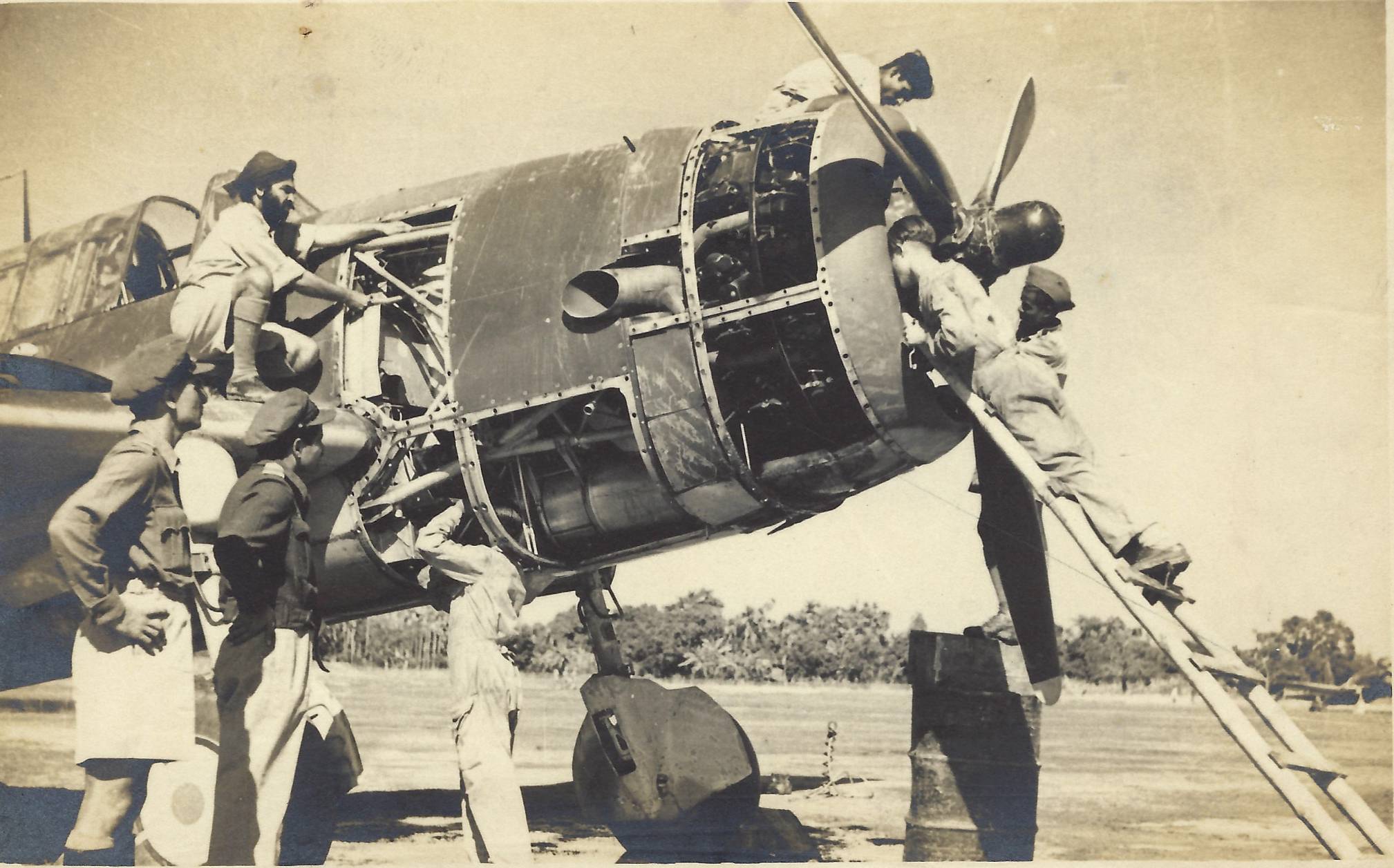
First numbers of the Vengeance dive bomber were delivered to No. 152 Operational Training Unit at Peshawar late in 1942. Towards the end of 1942, the Coast Defence Flights had been disbanded and general reconnaissance duties over the shipping lanes assumed by the R.A.F. Personnel of No. 3 (Calcutta) and No. 6 (Vizakapatnam) Coast Defence Flights together with IAF personnel withdrawn from Nos. 104 and 353 Squadrons R.A.F., were formed into No. 7 Squadron earmarked for the Vengeance. Conversion training on the Vengeance I started in mid-December 1942 and was completed by mid-February 1943. Technical and ground personnel received training on the Vengeance at 320 Maintenance Unit at Drigh Road, Karachi and on 8th March 1943, No. 7 Squadron assembled for operational training at Phaphamau. No. 8 Squadron, meanwhile, was formed on 1st December 1942 at Trichinopoly, absorbing remaining personnel of 6 C.D.F. and the Cochin Flight. Also raised on the Vengeance I, No. 8 achieved operational status on 25th June 1943.
Nobody was very happy about the Vengeance, least of all the U.S.A.A.F. for which it had originally been built for the Vengeance possessed more than its share of teething troubles and defects and had to be withdrawn for a while. Some pilots of No. 7 Squadron had a brief introduction to dive bombing in earnest when they carried out a few raids from Quetta against tribesmen in two North Waziristan villages at the end of January 1943. Still further, in Burma, the personnel of Nos. 7 and 8 Squadrons were determined to overcome the dive bombers problem and their pilots had to train them-selves on the fine points of dive bombing while actually on operations but such was their success that within a few months they could place their 500 lb. (227 kg.) bombs within 15 yards (13.7 m.) of the target.
While No. 7 Squadron trained in preparation for Wingate’s second expedition, No. 8 moved to Double Moorings, Chittagong and into battle in mid-December 1943 at the start of the second Arakan Campaign. The general practice was for the Squadron to fly in a formation of 12 aircraft—two “boxes” of six—and diving from 8,000 ft. (2,440 m.) at 320 m.p.h. (515 km/hr) with dive brakes on, the Vengeances would release bombs at about 2,000 ft. (610 m.) from ground with excellent results obtained in the Sinzweya battle, blasting Japanese underground defences in Razabil and Buthidaung areas. There was high activity in February 1944 and by July, when the Squadron was withdrawn, a total of 1420 sorties had been carried out. Continuing problems had however necessitated re-equipment of both squadrons with the Vengeance III in June.
No. 7 Squadron were committed nearly throughout the Imphal campaign, dive bombing Japanese targets in the Chindwin. No. 7 Squadron had arrived on the battlefront on 12th March 1944 and operated from the airstrip at Uderbund, near Kumbigram. Despite the deteriorating weather, the Vengeances of No. 7 Squadron flew 344 sorties in April 1944. On May 25th, diving through 10/10th cloud, Vengeances destroyed the vital Manipur bridge, a key link in the Japanese lines of communication above the Tiddim road. In completely overcast conditions, the Vengeances attacked strategic targets ranging from Myothit to Thaungdut, bombing supply camps in the Chindwin river, Imphal, Kalewa and Fort White areas. By mid-June solid cumulus nimbus cloud upto 10,000 feet (3,050 m.) made operations impossible and “the season for Vengeance dive bombing was definitely over”. The units had displayed a high degree of skill, the Vengeance having proved itself to be the most accurate form of “artillery” for attacking targets in mountain and jungle shrouded country; a classic remark of one Vengeance pilot after a mission to Akyab has endured : “As I went down I passed the target going up”!
By September 1944 all R.A.F. Vengeance units had converted to Mosquitos but No. 7, leaving their Vengeances at Allahabad, converted to the Hurricane in November while No. 8 converted to the Spitfire in October, their Vengeance Ills being handed over to 309 Maintenance Unit at Jodhpur.
The Vengeance soldiered on for a while, towing sleeves with Anti-Aircraft co-operation flights and being used for other miscellaneous tasks like their Mk. IV relations in England.
Notes :
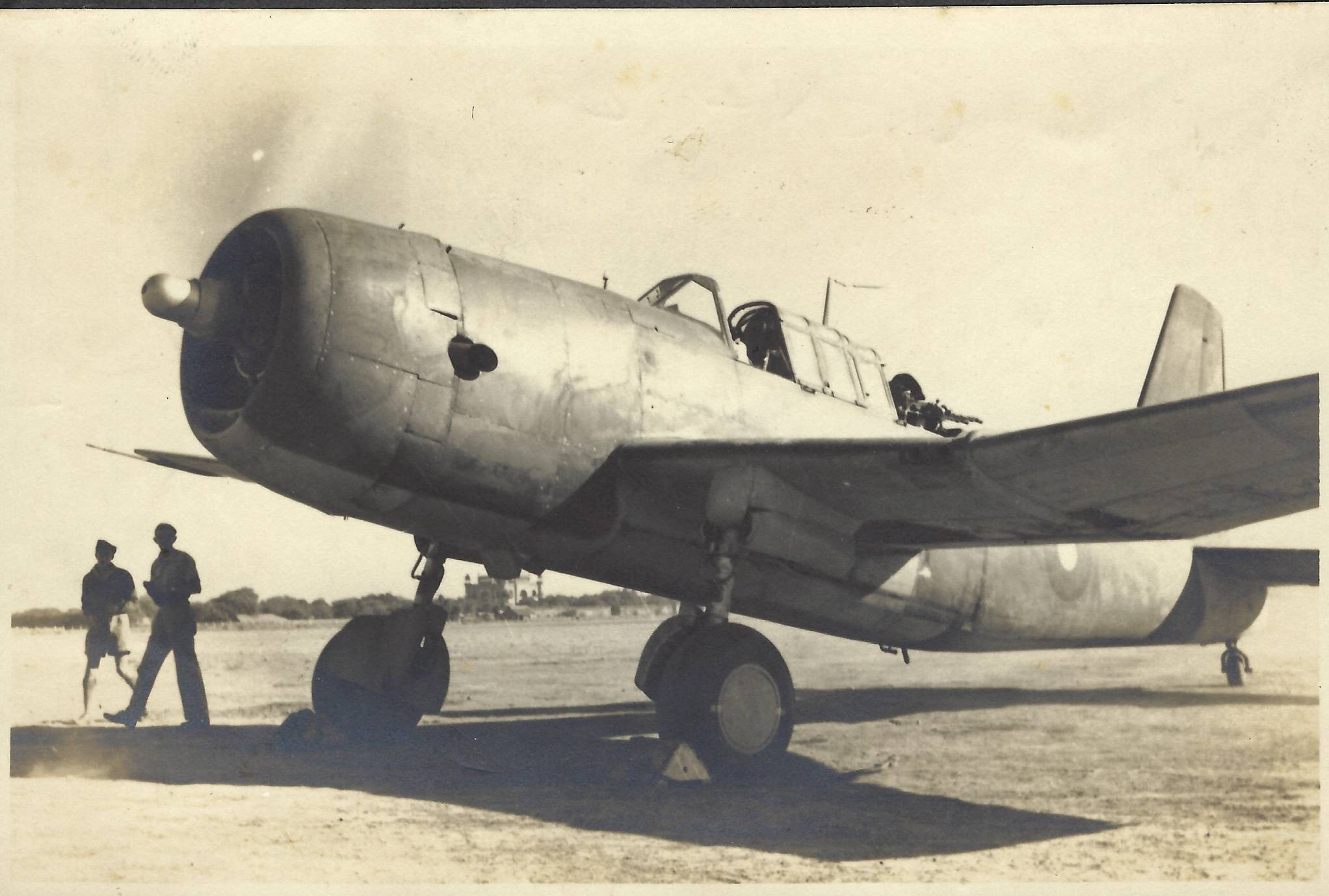
Reports of how French defence points were smashed by Ju-87 Stukas during the Nazi blitzkrieg in 1940 startled U.S. authorities into the realisation that conventional bombing techniques were inefficient against small or moving targets for which diving from well over 30° angles was required. Originating as the two-seat Vultee V-72 and ordered for the Royal Air Force in 1940, the aircraft had the U.S.A.A.F. designation A-31 and was christened the Vengeance in July 1941. The early Vengeance used the Wright R-2600-19 engine of 1600 h.p., had odd seagull wings, dive brakes, armour and leak-proof tanks. Contracts were placed for 500 from Vultee and 200 under licence from the reorganised Northrop Corporation, while lend-lease contracts in June 1941 added 400 Vultees and 200 Northrops to these orders. Northrop delivered 400 Vengeance 1 and IAs between January 1942 and April 1943 to the R.A.F. Vultee began quantity deliveries from a Nashville plant in March 1942 and 500 Vengeance IIs were followed by 100 Vengeance Ills. However, the R.A.F. did not require a dive bomber in Europe and the Vengeance only saw operational service in Burma.
| Country of origin | U.S.A. |
| Performance | Max. speed 275 m.p.h. (442 km/hr) at 11,000 ft. (3,353 m.) |
| Landing speed 80 m.p.h. (129 km/hr) | |
| Service ceiling 22,500 ft. (6,858 m.) | |
| Climb rate 19,700 ft./20.4 min (6,005 m/20.4 min) | |
| Range 700 miles/1500 lb. bombs (1127 km/680 kg. bombs) 1,400 miles (2,255 km.) ferry | |
| Armament | Four 30 calibre machine guns in wings (750 r.p.g.) Two 30 calibre machine guns flexible (500 r.p.g.) 1000 lbs. (454 kg.) of bombs in an internal bay |
| Weights | Empty 9,725 lb. (4,416 kg.) |
| Gross 12,940 lb. (5,876 kg.) | |
| Max. 14,300 lb. (6,492 kg.) | |
| Fuel | 320 gallons (1455 litres) |
| Dimensions | Span 48 ft. (14.63 m) |
| Length 39 ft. 9 in. (12.12 m.) | |
| Height 15 ft. 4 in. (4.67 m.) | |
| Wing area 332 sq. ft. (30.84 sq. m.) |