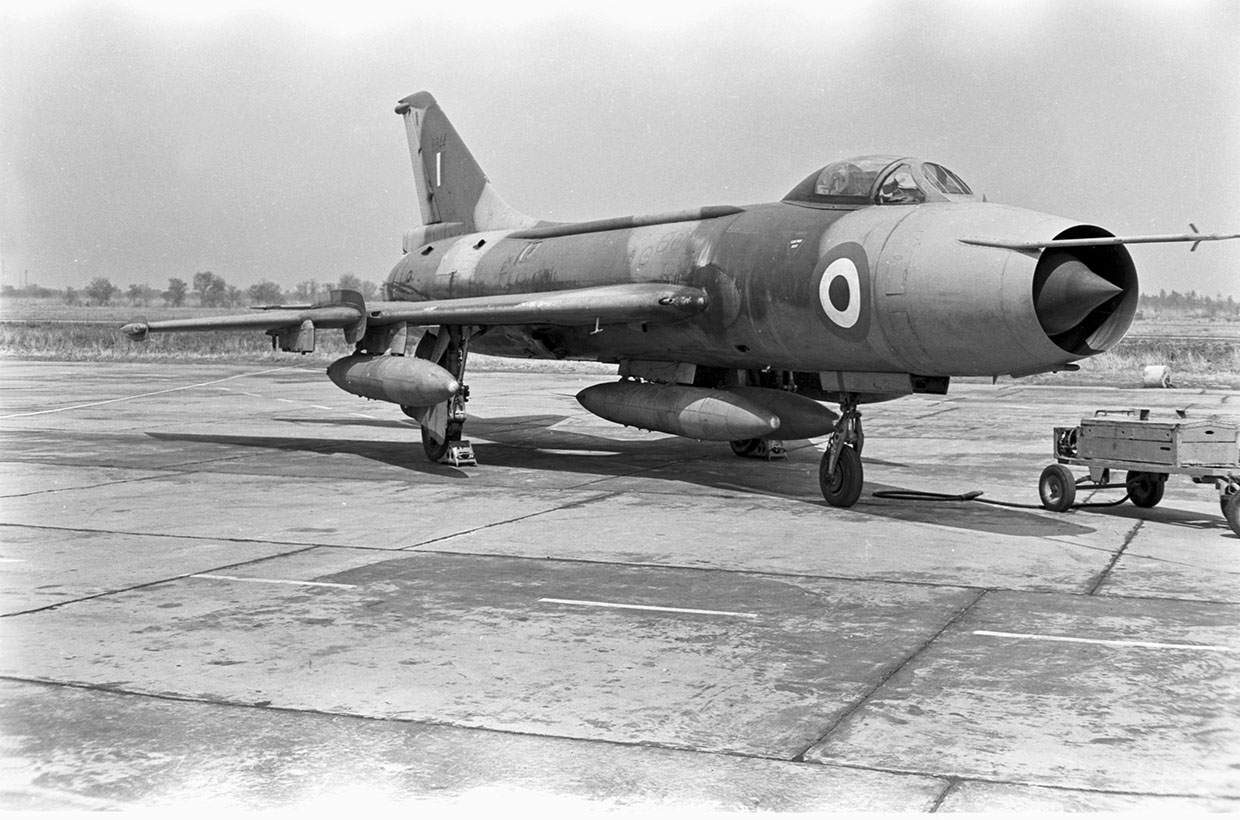


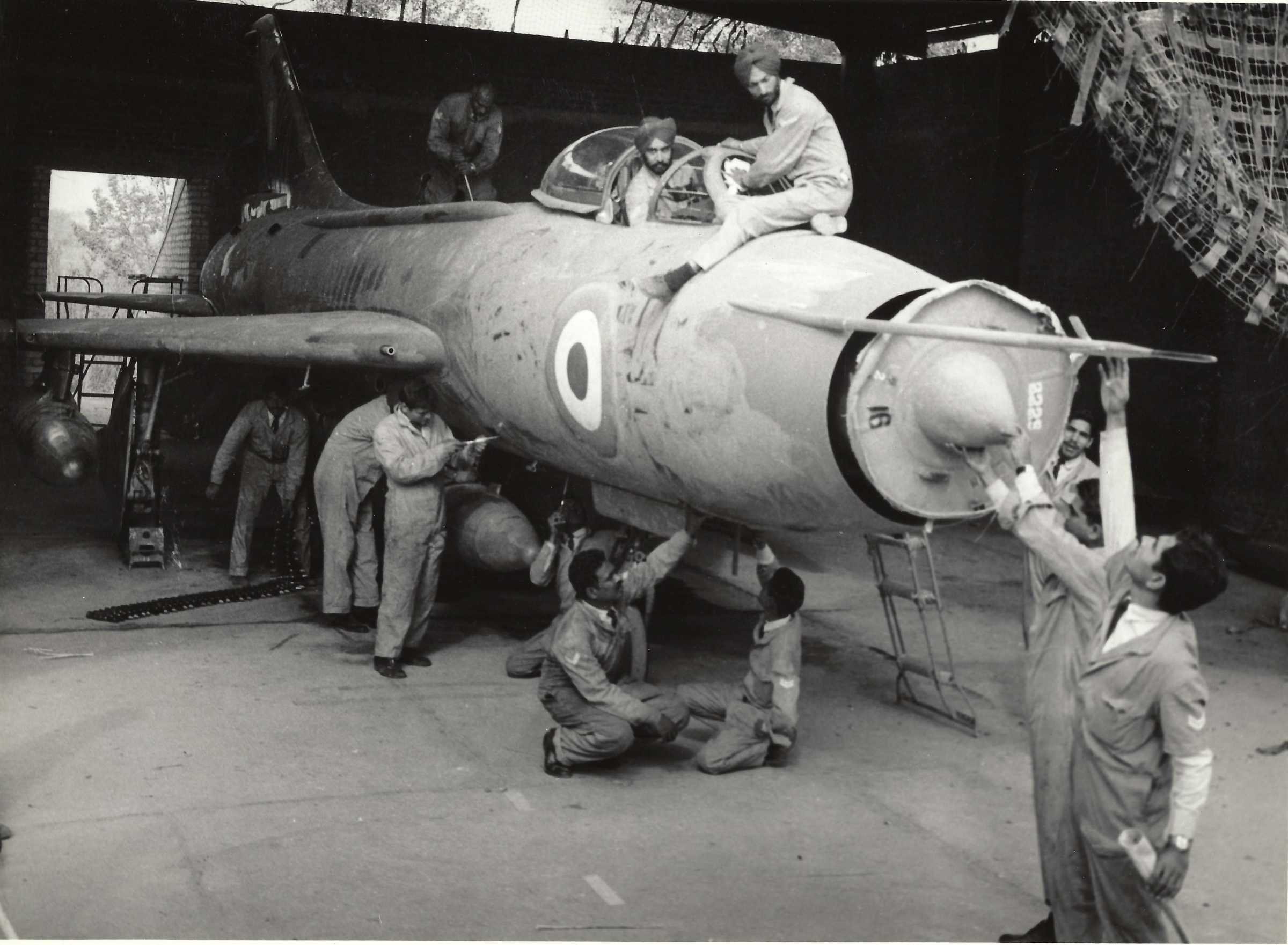


Delays in availability of the ‘definitive’ HF-24 and the gap in I.A.F.’s inventory for a supersonic ground attack aircraft led the Indian Government towards evaluating the Soviet Su-7 ground attack fighter in the summer of 1966 and the supply of some 100 Su-7BMKs and a dozen Su-7U tandem-seating ground attack fighter-trainers at a reported cost of $ 100 million. The first Su-7s were received in March 1968 crated and by sea at Bombay, assembled at Santa Cruz to eventually form the equipment of six squadrons (first to form being No. 26), another 40-odd Su-7s being received in 1971. Given the designation TYPE S-22, the aircraft in I.A.F. service were modified to the services’ requirement in being able to carry extra drop tanks under the belly, a recon-naissance camera-pod as also RATO attachments.
Following Pakistan’s pre-emptive strike attempt on the evening of 3rd December 1971, Su-7s were amongst the first aircraft in counter-action on the 4th morning and till the ceasefire on 17th December, the Su-7 squadrons were responsible for the bulk of attacks by day on enemy targets, flying some 2500 offensive sorties ranging from counter-air to interdiction and close support for the army. Su-7s of No. 222 Squadron attacked Risalwala airfield on the 4th December morning while four Su-7s of No. 101 Squadron, each with 2×500 kg. bombs and escorted by two MiG-21FLs of No.1 Squadron, mounted a lo lo lo attack on Pasrur airfield. No.101 was in the forefront at Chhamb, relieving pressure on the embattled 10th Infantry Division, destroying enemy armour with 57 m.m. rockets at the Munnawar Tawi crossing near Raipur and following up by attacks on troop and tank concentrations in both the Chhamb and Sialkot sectors with over 60 tanks and 25 field artillery positions shot up. Su-7s were in close support of I and XI Corps in the Punjab from Dera Baba Nanak to Fazilka, concentrating efforts around Fazilka-Ferozepore to disperse a major Pak. armoured build up. Enemy tanks concealed in haystacks and under groves were attacked with rockets and bombs in the area from Hussainiwala and Chitian Mandi to Dera Baba Nanak and in the Sejra Bulge, maximum efforts by the Su-7s being put in between the 8th and 12th December.
Escorted by MiG-21s and Gnats, the Su-7s were also employed in the interdiction role, attacking the railway system south of Lahore by day, a particularly successful action amounting to destruction of the railway marshalling yards and a supply train at Raiwind on the Kasur-Lahore railway. Interdiction missions were also mounted on Montgomery, Changa Manga and Narowal railway stations. Su-7s damaged the Sulemanki headworks by bombs on the 4th December, the extensive damage being confirmed by photo-recon-naissance Su-7s. Su-7s fitted with a P.R. camera pod were active over most of the Wes-tern front and one aircraft on a P.R. mission at 4,000 m. over Risalwala airfield held its own in air combat by shooting down a Pak. MiG-19. Sixteen, Su-7s attacked and heavily damaged the marshalling yards near Lahore paralysing the transportation system for weeks. In the East, Su-7 formations from Panagarh initially flew counter air sorties against enemy airfields and latterly interdicted traffic and riverine craft and lent close support to the Army.
The Su-7 had to run the gauntlet of concentrated ground fire and, being a very large air-craft, provided an easier target as most missions were required to be flown by day and below 100 m. where its performance in the maximum dry thrust regime was poor. Losses were commensurately heavier than those of other types although the Su-7s could take considerable punishment. One Su-7, hit by an air-to-air missile, flew back to base with pieces of the missile embedded in the fuselage while another Su-7, with most of its control surfaces shot away by ground fire, was successfully recovered from deep inside hostile airspace.
However, having a relatively modest ordnance carrying capability as it does, the Su-7 has been considered as only an interim type and would be steadily phased out, its service with the I.A.F. having been relatively shorter than that of any other combat type since 1947.
Notes :
Evolved in parallel with the Su-9 all weather interceptor fighter, the Su-7 was specifically developed for the close support and ground attack roles, the wing leading-edge sweep angle of 62° offering a marked superiority over the delta wing at subsonic speeds in being able to attain higher lift co-efficients without buffeting. The prototype flew in 1955 and the Su-7 is believed to have entered service with the Soviet Frontovaia Aviatsiya in the late fifties. The Su-7 has been exported to East European and some Arab countries as also Afghanistan and India. The very large Su-7 is powered by a single massive turbojet, the Lyulka AL-7F-1 rated at 14,960 lb.s.t. (6,800 kg.) or 21,120 lb.s.t. (9,600 kg.) with reheat.
| Country of origin | U.S.S.R. |
| Armament | Two 30 m.m. NR-30 cannon with 70 r p.g. and two 1100 lb. (500 kg.) bombs or two BY-57B pods with 16x57 m.m. rockets each; two ASMs or two 600-litre drop tanks distributed between four external stores stations; Photo recce. camera pod. |
| Performance | (Clean) Max. Speed 1,056 m.p.h. (1,699 km./hr.) at 40,000 ft. (12,190 m.); 720 m.p.h. (1,158 km./hr.) at 1,000 ft. (305 m.) |
| Initial climb rate 29,500 ft./min. (8,990 m./min.) | |
| Combat radius (hi lo hi profile) 285 miles (458 km.) | |
| Weights | Empty 19,000 lb. (8,628 kg.) |
| Normal take off 26,455 lb. (12,000 kg.) | |
| Max. take off 29,600 lb. (13,440 kg.) | |
| Dimensions | Span 31 ft. 2 in. (9.50 m.) |
| Length 55 ft. 9 in. (16.99 m.) | |
| Height 15 ft. 5 in. (4.7 m.) |