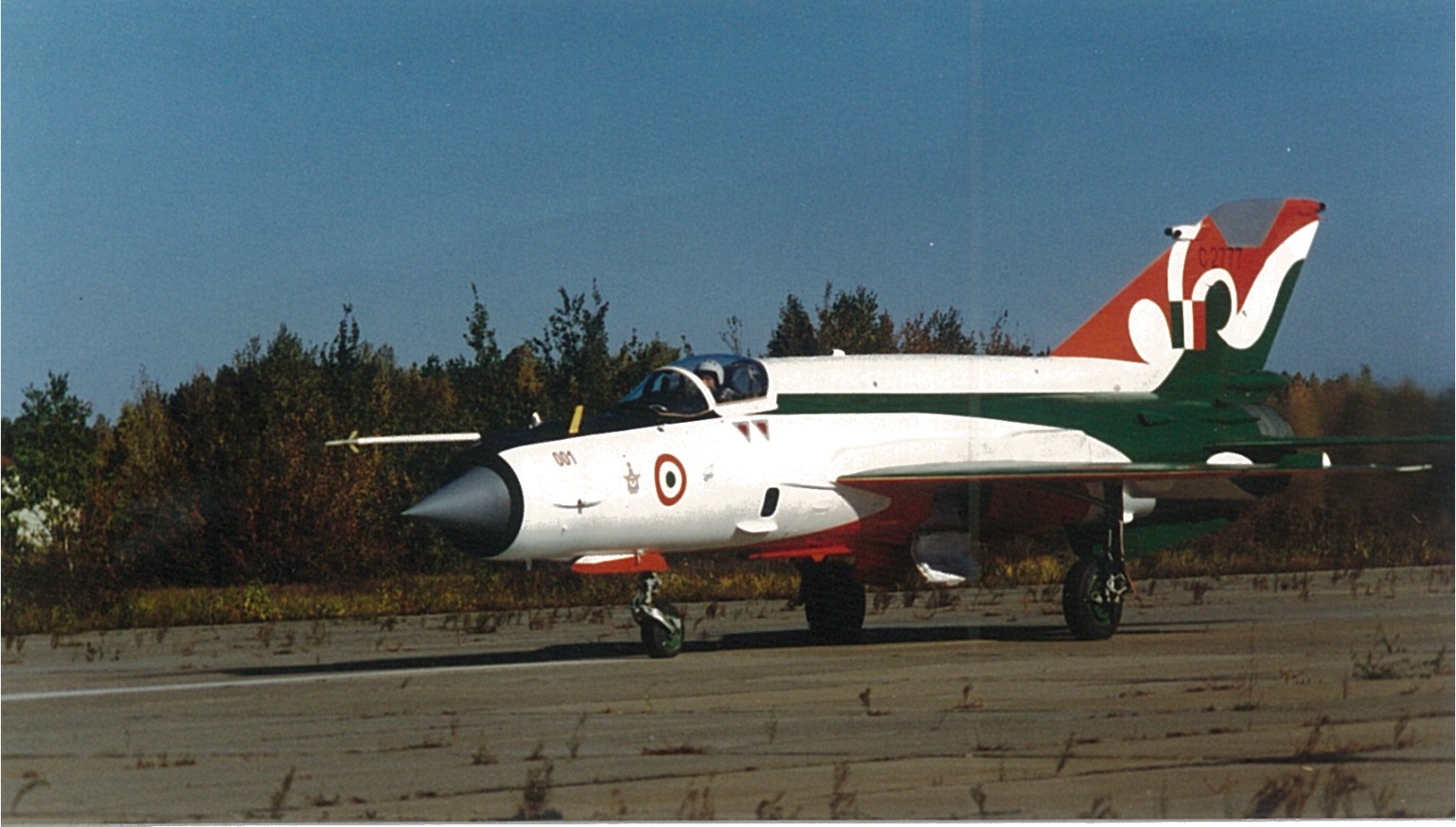
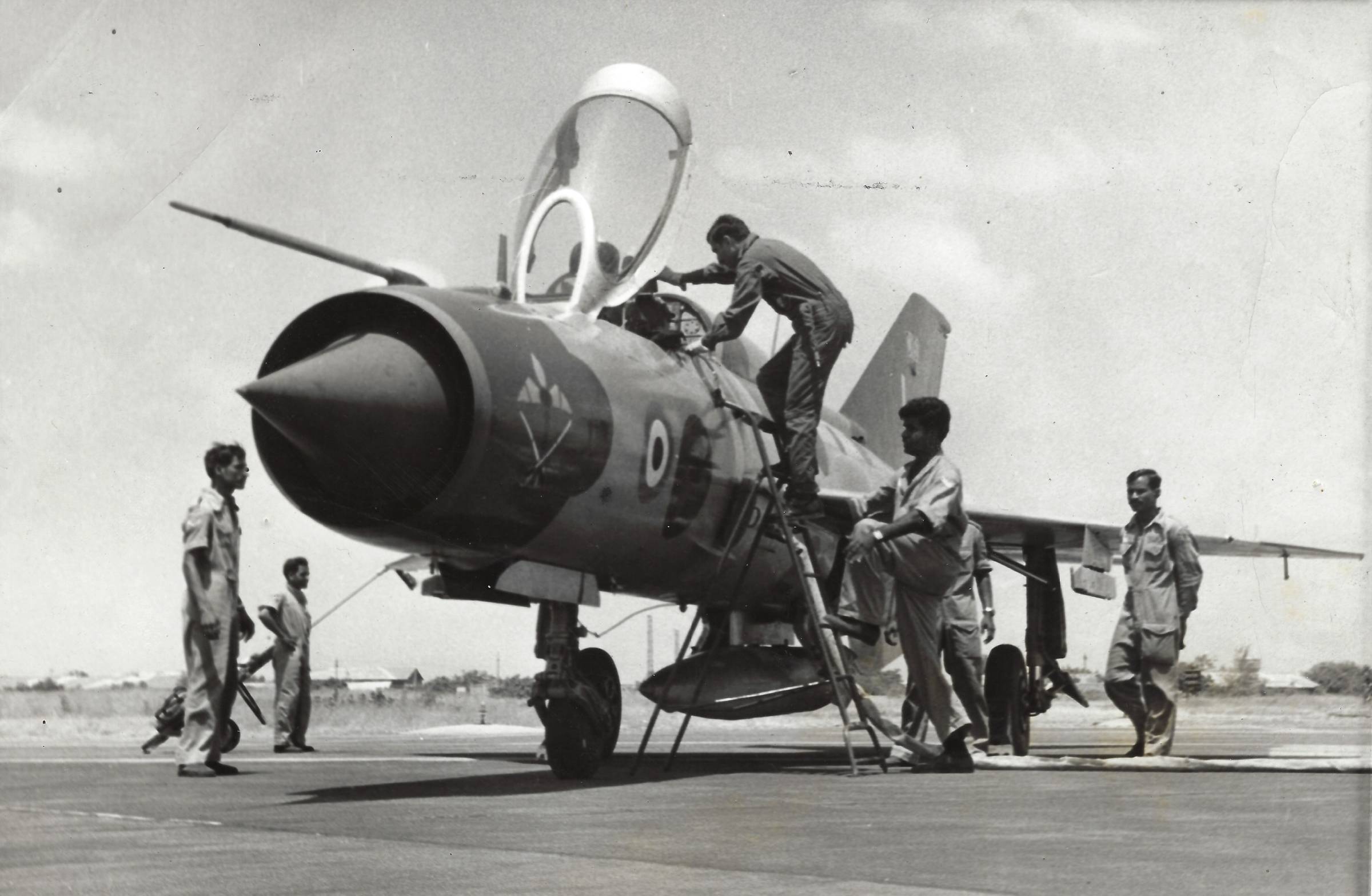

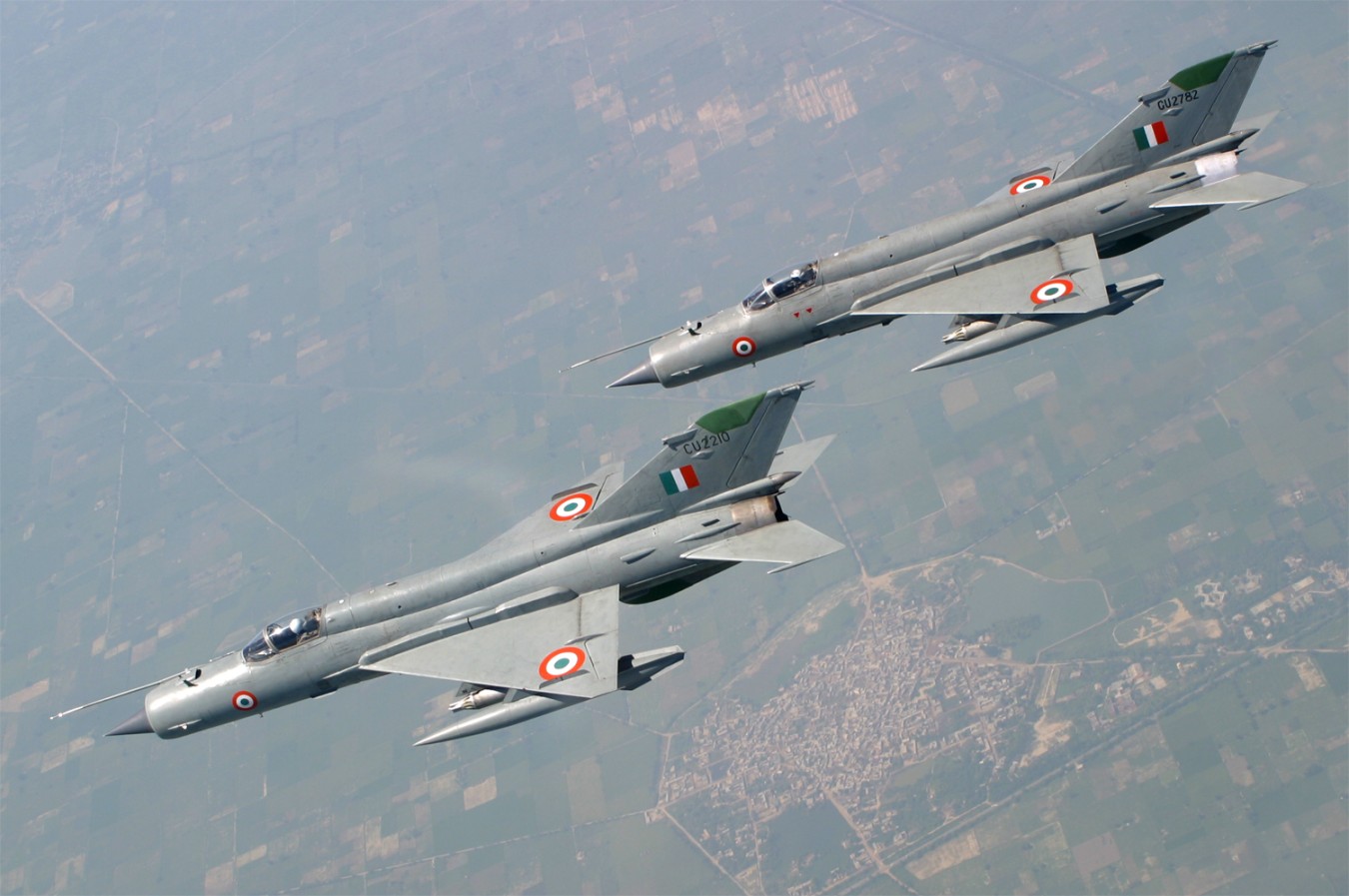


MiG-21F-13 (TYPE 74), MiG-21FL (R1L) (TYPE 76), MiG-21FL (R2L) (TYPE 77), MiG-21M (F) (TYPE 88), MiG-21U (TYPE 66)
Throughout most of 1962, political jockeying kept the MiG-21 deal on the front pages. The contract, sought to be signed with the USSR for the initial supply, and eventual manufacture, of the Russian fighter in India marked a watershed in the procurement of combat aircraft for the Indian Air Force. While the U.S.A. and U. K. belatedly offered to counter the Soviet contract with promises of F-104s or Lightnings, the Indian Government concluded an agreement in August 1962 which provided for the Indian purchase of twelve MiG-21s and for Soviet technical assistance in establishing production facilities for the type in India.
A batch of eight I.A.F. pilots arrived at Lugovaya, in Kirgizya, on 8th October 1962 for a three-month conversion training course transitting to the MiG-21 via the UTI MiG-15 and MiG-17. The first batch of six aircraft left Odessa by sea on January 15th 1963 and reached Bombay on January 28th, leading to the formation of the first unit (No. 28 Squadron) on the MiG-21 in April 1963. The aircraft were MiG-21F-13s and, given the I.A.F. designation TYPE 74, were intensively evaluated under Indian conditions but their obvious shortcomings were modest fuel capacity (2340 litres) with consequent short radius of action and the simple radar ranging in a small intake-nose cone which rendered them unsuitable for all-weather operations. Owing to the critical weight factor, fairing over of the port cannon was suggested but the I.A.F. preferred to retain both 30 m.m. cannon on some of its Type 74s. A second batch of six MiG-21s reached India in mid-1964, two of these being later models featuring a completely redesigned forward fuselage with the engine air intake substantially enlarged in diameter to permit installation of a centrally mounted AI radome, to produce a double shock to improve high speed thrust. The AI radome contained the type R1L search and track radar and this MiG-21FL (designated TYPE 76) carried more fuel (2850 litres) than the Type 74.
It had been planned to procure another eighteen aircraft in 1965 but the simmering Sub continent erupted into full-scale war in September and the I.A.F. went to war with its MiG-21 trials-squadron boasting of only 8 serviceable aircraft (two had been lost in mid-air collision during training on 21st December 1963). The handful of MiG-21s played a limited role during the three weeks of warfare, only being utilized for combat air patrol duties over two forward air bases in the Punjab but did not see action. The expectant and long awaited clash with the F-104As of the Pakistan Air Force never took place and military observers and analysts the world over continued only to speculate on what might have been.
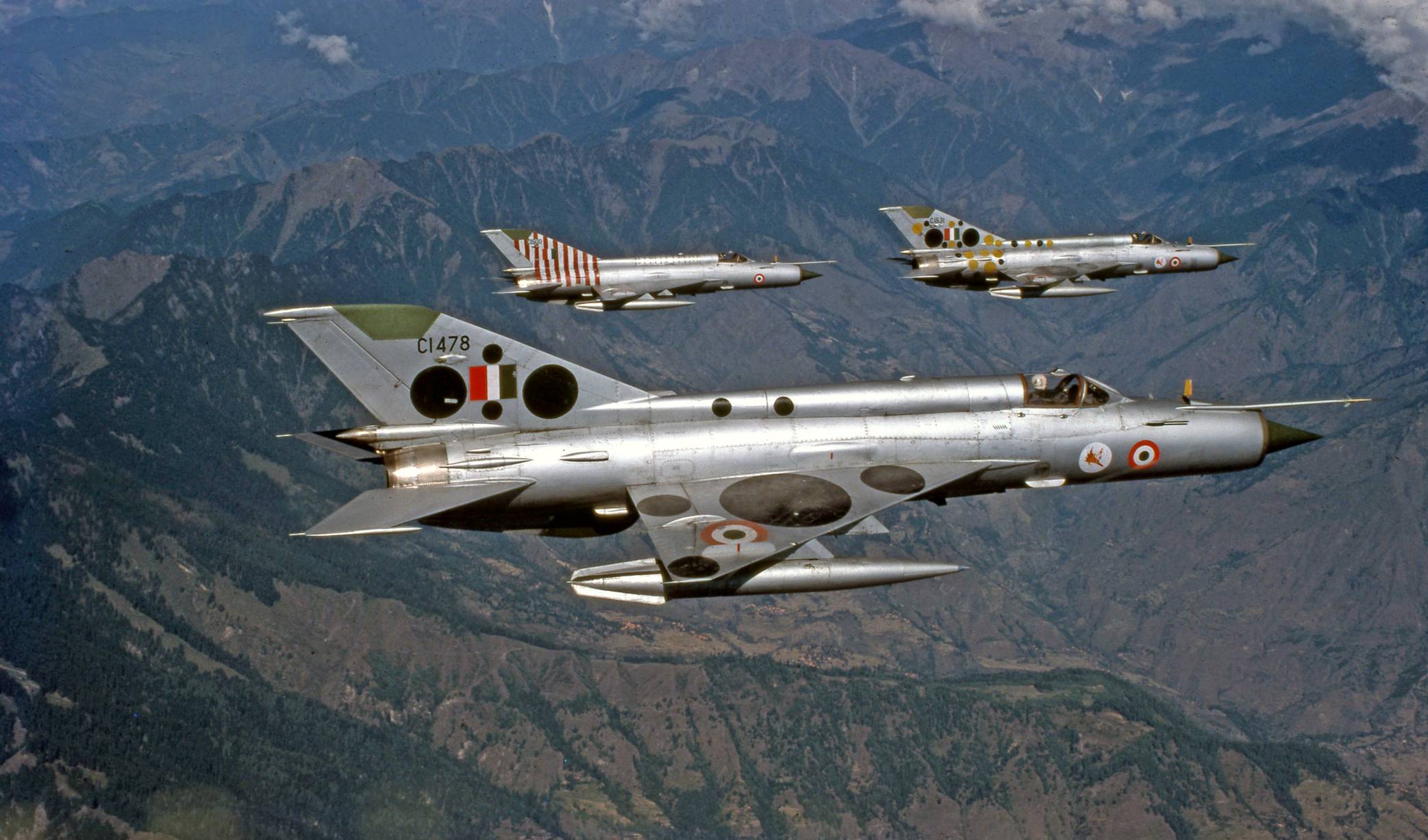
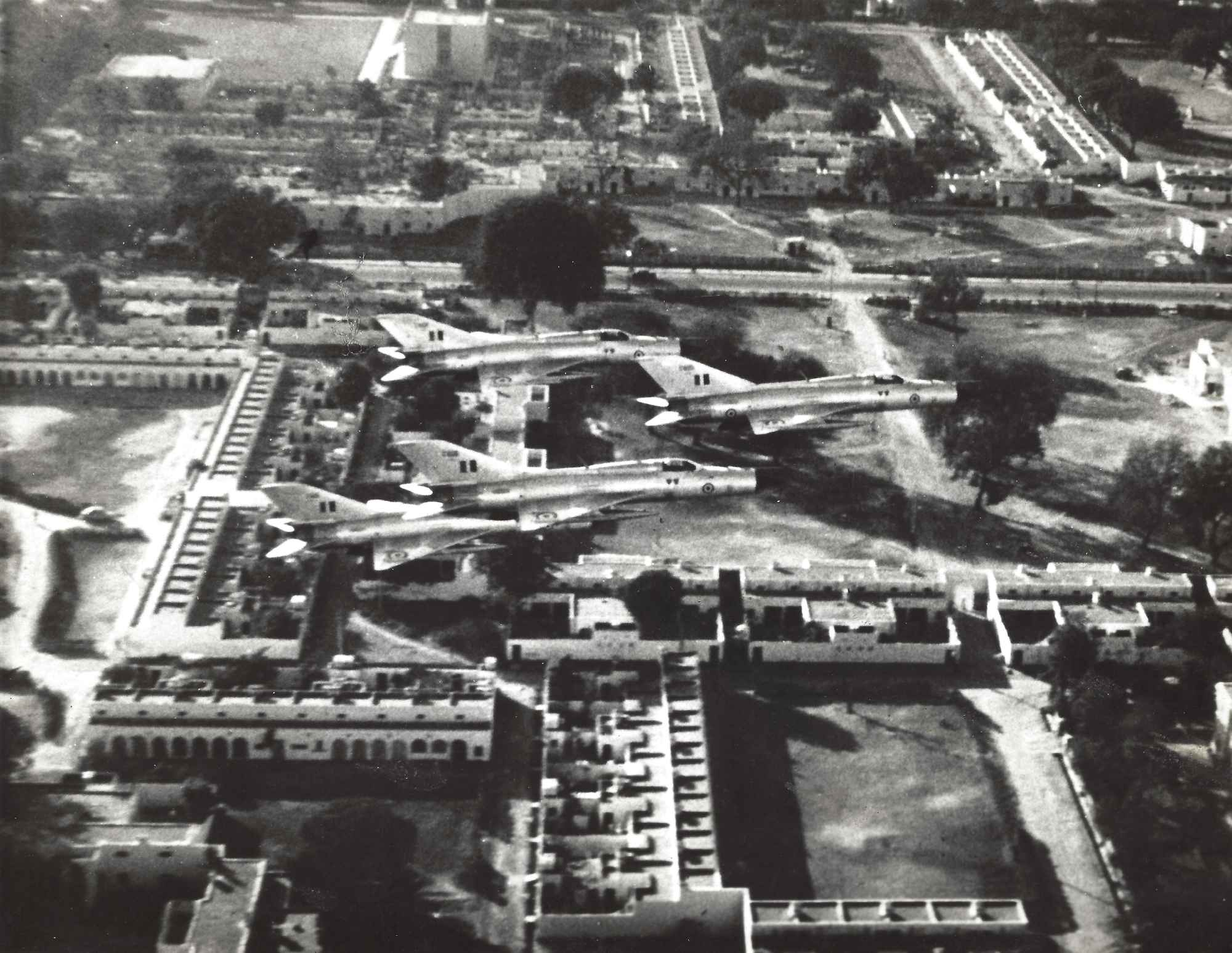
Major expansion of the MiG-21 force in the I.A.F. took place between the years 1966-68, India obtaining sufficient numbers from the U.S.S.R., both complete and in CKD assembly-form, to re-equip six of its fighter squadrons supplanting, variously, such types as the Mystere IVA, Ouragan and Vampire F.B.52. In late 1964 the original manufacturing plans had been modified as too ambitious and in mid-1966, the Ministry of Defence Production announced that the MiG-21 manufacture programme was to proceed in four distinct stages starting with assembly from major components, advancing to sub-assemblies, parts and finally, raw materials. In order to assist the programme, a batch of MiG-21s purchased from the U.S.S.R. were test flown in Russia, dismantled, shipped to India and reassembled at Nasik under Russian supervision. The manufacturing project was handled by the specially created Aeronautics (India) Ltd. (later MiG-Division of Hindustan Aeronautics Ltd.) with airframe factory at Ozar, Nasik, powerplant factory at Koraput (Orissa) and ancillary factory for avionics and missiles at Balanagar, Hyderabad. The definitive version selected for import and manufacture was the MiG-21FL (Forsazh Lokator), designated TYPE 77, which differed, primarily in the airborne radar, the type R2L search and track system being fitted. Also received in late 1965 were a number of MiG-21U (Uchebne) tandem-seating trainers of the “Mongol-A” version and designated TYPE 66-Series 400 in the Indian Air Force. The first MiG-21FL airframes assembled by HAL (with imported powerplants) were delivered early in 1967 and progressive manufacture developed on schedule with HAL handing over the first MiG-21FL built from raw materials (C 1100)to the I.A.F. on 19th October 1970. Production of 196 MiG-21FLs was completed in 1973, the first HAL-built R-11-F2S-300 twin spool turbojet having been delivered on 2nd January 1969.
The MiG-21 represented an entirely new generation of combat aircraft of the Mach 2-missile age and the I.A.F. adapted new techniques in operations, maintenance and employment of supporting ground environment systems. The Type 77 was a superb aircraft for tight manoeuvres and had excellent handling characteristics and high performance, the technical staff being as enthusiastic about its servicing and maintenance simplicity, but the I. A. F. demanded that the MiG-21s be urgently modified in the aspect of relatively weak armament and range. Consultations with the Russians led to some major improvements, the main heads of modification concerning an increase in internal fuel capacity, better-quality tyres (for high altitude airfield operation), more effective brake pressure and the eventual incorporation of larger capacity drop tanks, a gun-gondola and a gun sight. The GP-9 gondola, containing the twin barreled 23 m.m. GSH-23 cannon, and predictor gun sight with an electrical ranging system, were imported as kits from the Soviet Union and modifications effected by Base Repair Depots of the I.A.F.. The cannon pod became an additional notch in the confidence factor, pilots no longer having to face the uncomfortable prospect of being left unarmed after the two infra-red homing missiles were fired in the first few seconds of combat. In place of the 490-litre ventral auxiliary fuel tank, the I.A.F. modified its MiG-21s to carry similar capacity drop tanks under each wing thus greatly increasing endurance, range and firepower.
Some 40 MiG-21Us (including the “Mongol B” variant, designated TYPE 66-Series 600) were obtained and fighter squadrons normally retain two of these MiG-21 trainers on strength although conversion training was initially conducted by No. 45 Squadron which was the second formation with the MiG-21. For some years, MiG-21 squadrons were assigned a dual function, all-weather air defence as well as a major ground-attack responsibility till the latter was assumed by the Sukhoi Su-7BMK from 1968 onwards, and the I. A. F. trained its pilots accordingly, transforming the Type 77 into a more versatile weapon-system, radically different from the merely high-altitude point defence interceptor as envisaged in its original design concept.
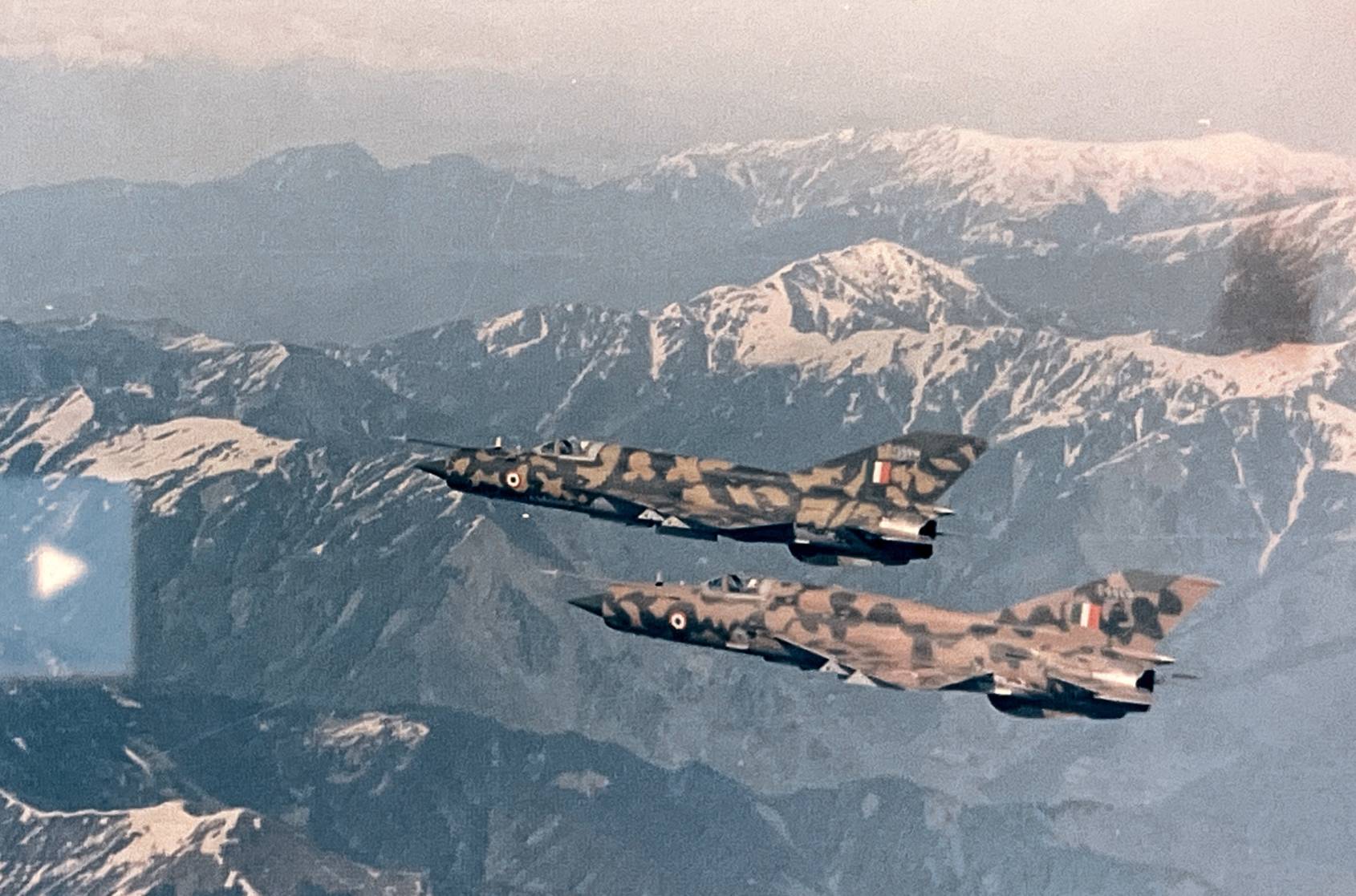
The world was treated to a dramatic display of the MiG-21’s capabilities during the December 1971 conflict. Of the eight MiG-21FL operational squadrons, five were deployed for air defence duties in the West and three spearheaded the strike attacks in the East. Bearing out Trenchard’s dictum on using scouts offensively, the Indian Air Force conducted frequent fighter sweeps with MiG-21s deep into Pakistani airspace but failed to provoke aerial combat even though the MiG-21s were flown at altitudes ranging from 7 to 10 kilometres high and upto 150 kilometeres inside hostile territory. Indian radar tracking Pak. aircraft scrambles recorded that these aircraft invariably turned back to perform immediate CAPs over their bases and the use of “decoys” in the shape of lower flying Hunters and Su-7s proved no more successful. MiG-21FLs in pairs escorted day strike missions and virtually all Su-7 sorties against enemy airbases, troop concentrations and field positions were given a MiG-21 cover as were the HF-24s further south on the desert front. There was no opportunity for the MiG-21 to make a bad weather or night interception of enemy raiders but P.A.F. F-104s on marauding missions in the southern sector were tackled with positive results gained. MiG-21FLs, detached to a number of airfields in Rajasthan and Gujerat were on the lookout for the Jordanian F-104s given to Pakistan as “war loan” and the first of these fell to a MiG-21FL of No. 47 Squadron near Jamnagar on 12th December, the F-104A being shot down by cannon following an after-burner chase at low level over the Gulf of Kutch. A detachment of No. 29 Squadron in the Thar desert achieved four quick victories on the last two days of the war. On the 16th December, two MiG-21FLs escorting four Maruts on a low level strike mission against targets along the Naya Chor-Mirpur Khas axis, were accosted by three MiG-19s. In the resulting dogfight one MiG-19 (Shenyang F-6) of the P.A.F. was shot down by the MiG-21’s cannon fire after three-minutes evasive action. On the 17th morning a MiG-21FL was scrambled after a low flying F-104 was reported near Uttarlai airfield and in a classic missile attack, the MiG-21’s second K-13 infra-red homing missile exploded near the F-104A which crashed a few miles away. A few hours later, two MiG-21FLs escorting four Maruts on a strafing mission north of Umarkot, flew head on against two F-104As. In the ensuing air combat, the MiG-21’s superior turning performance, incredible acceleration and manoeuvrability in both vertical and horizontal planes, was the decisive factor. Flying largely on re-heat, the two F-104s were shot down by K-13 missiles in an action lasting two minutes. The four air actions spelt out clearly the capability of the MiG-21 as an air superiority weapon when flown by well-trained pilots. Equally impressive was the MiG-21s’ debut as a counter air and ground attack fighter in the east. The first offensive raid was carried out by No. 28 Squadron, four MiG-21s carrying 500 kg. M-62 bombs, escorted by two MiG-21s with K-13s, attacking Tezgaon airbase near Dacca at 0800 on 4th December. In the ceaseless attacks, by day and night, both Tezgaon and Kurmitola airfields were rendered non-operational, all repair-attempts abandoned and three intercepting Sabres shot down by K-13 missiles. The MiG-21s remained in the forefront of one of the most decisive applications of airpower. The camouflaged MiG-21s were on constant call for close air support to the army as the lightning campaign progressed and scores of bunkers, POL dumps, gun positions, vehicles and riverine craft were destroyed by 57 m.m. rockets. Perhaps the most spectacular strike was that on the Government house in Dacca on 14th December. Within 15 minutes of a message-interception by Indian Intelligence, six MiG-21FLs of Nos. 4 and 28 Squadrons with BY-57B rocket pods were airborne and with only a tourist guide map of Dacca as reference, an accurate rocket attack on Government house was carried out, the top-official meeting inside disintegrating and the puppet-Government resigning. Perhaps for the first time in history, aircraft were used in mopping up actions inside a city. In an operation coded “Street fighting”, MiG-21 FLs also carried out precision rocket attacks on Pakistani troops sealed up in Dacca University campus for a last-ditch stand.
In the West, MiG-21s were used to provide a line-of-sight VHF link between low flying I.A.F. raiders and their controlling stations in the Punjab. Coded “Sparrow”, the MiG-21s flew standing patrols and were eventually exaggerated by the Pakistanis who claimed them to be Tu-114M AWAACS aircraft, flown by Russians !
Later model MiG-21s have been considered by the Indian Air Force and HAL has switched to production of the MiG-21M (Modifikatsirovanny) from 1973-74. The first “M” (C 1532) was handed over at a ceremony at Nasik on 14th February 1973 after exhaustive evaluation at the Aircraft and Systems Testing Establishment. The first MiG-21Ms were powered by the R-11 engine but the R-13 engine will eventually power the aircraft to be produced in quantity at Nasik and this aircraft will, in fact, be the MiG-21M(F), designated TYPE 88 by the I.A.F.. Some MiG-21MFs have been purchased directly from the. U.S.S.R. and about 150 are to be manufactured by HAL. The aircraft will essentially incorporate two 23 m.m. cannon contained in a flushed underbelly pack, five hard points and a zero-zero ejection seat.
Without doubt, the Types 66, 77 and 88 will be predominant shapes in Indian skies in the decade ahead.
Notes :
Development of Artem Mikoyan’s MiG-21 air superiority fighter was a direct fallout from the experience gained in the MiG-15 vs. Sabre combat in the Korean war. The first prototype MiG-21 (coded “Fishbed A” by NATO) flew initially in 1955 and its production version, the MiG-21F (Fishbed C”) was a short-range clear-weather fighter with two NR-30 cannon and limited avionics. The emphasis was placed on good transonic and supersonic handling, high rate of climb, small size and light weight, using a turbojet engine of medium power in contrast to the contemporary and much heavier and more powerful Su-9. The MiG-21PF (“Fishbed D”) was the basic model of a new series with enhanced all weather capability and the MiG-21FL powered by a R-11-F2S-300 turbojet developing 6200 kg. reheat thrust was an export version, with some modifications in avionics. The escape system is based around a semi encapsulated style in which the canopy is ejected with the seat. The nose cone is variable and, fitted with a sensor, adjusts automatically according to forward speed and air density, retracting at higher speed and modulating air so it remains subsonic. Artificial feel for longitudinal control is provided by the ARU-3V q-feel power stabilizer system. The two-seat training versions (coded “Mongol”) are generally similar to the MiG-21F but have two cockpits in tandem with sideways-hinged double canopy, the “Mongol-B” having an acorn-type parachute-brake housing and a “damage-simulator” in the instructor’s cockpit.
The MiG-21MF (“Fishbed J”) is the latest multi-role version and has a deeper dorsal fairing above the fuselage, JATO attachments on each side of rear fuselage and is powered by a titanium-construction RX/R-13 turbojet of 6600 kg. thrust with reheat.
MiG-2ls in varied configuration have set up FAI-recognised records also holding, as the E-66, the world absolute speed record. Thousands of MiG-21s serve with the Soviet Air Forces and have been extensively exported to Communist and third world nations.
| Country of origin | U.S.S.R. |
| Armament | Two K-13(Atoll) air-to-air missiles on inner pylons plus (under belly) |
| GP-9 gondola containing GSH-23 23 m.m. cannon; | |
| BY-57B rocket pods (each with sixteen 57 m.m. rockets); | |
| two 500 kg. M-62 bombs or S-24 130 m.m. rockets | |
| Performance | Max. level speed above 36,000 ft. (10,970 m.) |
| 1,385 m.p.h. (2,228 km./hr.) (Mach 2.1) | |
| Service ceiling 59,000 ft. (17,990 m.) | |
| Radius of action 220 miles (350 km.) | |
| Weights | AUW 18,788 lb. (8,527 kg.) |
| Dimensions | Span 23 ft. 5 ½ in (7.15 m.) |
| Length 51 ft. 8 ½ in. (15.76 m.) | |
| Height 14 ft. 9 in. (4.50 m.) | |
| Wing area 247 sq. ft. (22.95 sq. m.) |