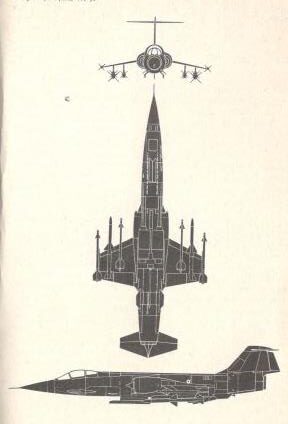
Designed by Lockheed’s ace engineer Clarence “Kelly” Johnson to surpass the MiG-15 fighters that had stunned the aeronautical world in Korea, the F-104 Starfighter was something completely different: an inexpensive lightweight fighter with thin seven-foot wings, sharp as the blade of a dagger. It was not only capable of reaching Mach 2 speeds but was sturdy enough to weather any storm that loomed before it. In short, it was the perfect NATO warplane.
Initially Lockheed’s sole responsibility was to sell the design and assist West Germany in getting its F-104 program started, but when production overseas began running into delays, Lockheed stepped in to ensure a smoother production process.
It sent experts to help West German engineers more efficiently translate Lockheed plans, technical orders, and unfamiliar parts into actual fighters. Then Lockheed ensured more dependable production cycles by developing a program called SURE (Starfighter Utilization Reliability Effort), which sent aerodynamicists, pilots and service reps to troubleshoot issues as they arose.
Lockheed would then launch specialized training programs funded entirely by the company to familiarize inexperienced German pilots with their new planes, drastically reducing the number of in-flight accidents.
The collaboration between the German government and Lockheed was so successful that other foreign nations quickly followed suit, purchasing licensing rights for the aircraft over the ensuing decades. By 1980, when the last Starfighter was manufactured, some 14 countries—including Canada, Japan, Turkey, Italy and Taiwan—had operated F-104s, using them in a multitude of roles, from interceptors and ground-attack aircraft to reconnaissance jets.
| Country of origin | U.S.A. |
| Power Plant | One 11,870 lb (5,385 kg) dry and 17,900 lb (8 120 kg) reheat General Electric J79-GE-19 turbojet. |
| Performance | Max speed, 910 mph (1470 km/h) or Mach 1.2 at sea level, 1,450 mph (2 335 km/h) or Mach 2.2 at 36,000 ft (10,m970 m); max cruise , 610 mph (980 km/h) at 36,000 ft (10,970 m); tactical radius with two 162 Imp gal (736 I) and two 100 lmp gal (455 I) drop tanks, 874-0-775 mls (1 190-1 245 km); ferry range, 1,815 mls (2,920 km); initial climb 50,000 plus ft/min (254 plus m/sec). |
| Armament | (Interceptor) One 20-mm M-61 rotary cannon, two AIM-7 Sparrow III and two AIM-9 Sidewinder AAMs. |
| Weights | Empty equipped (interceptor), 15,006 lb (6,807 off 31,000 lb (14,060 kg).kg), (strike fighter), 15,761 lb (7 149 kg); loaded (clean), (strike fighter), 21,585 lb (9,791 kg); max take off 31,000 lb (14,060 kg). |
| Dimensions | Span 21 ft 11 in (6,68m) |
| Title | Length 54 ft 9 in (16,69 m) |
| Height 13 ft 6 in (4,11 m) | |
| Wing Area 196.1 sq ft (18,22 m2) | |