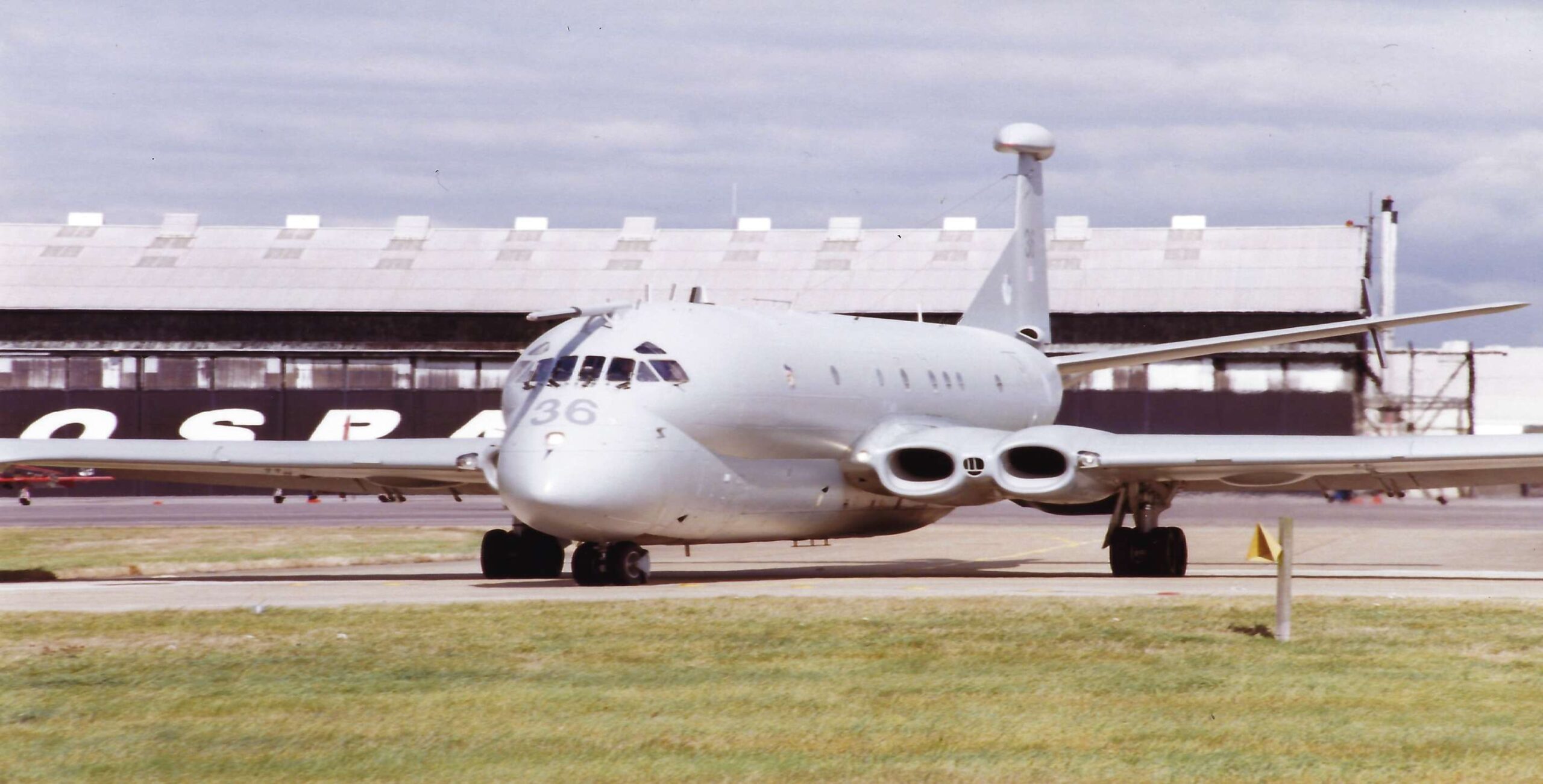
Long-range maritime patrol aircraft. First of two Nimrod prototypes employing modified Comet 4C airframes flown May 23, 1967. First of initial batch of 38 production Nimrod M.R. Mk. 1s flown on June 28, 1968. Completion of this batch in August 1972 followed by delivery of three Nimrod R. Mk. 1s for special electronics reconnaissance, and eight mote M.R. Mk. 1s on order with deliveries continuing through 1975.
Entire fleet to undergo refit programme as Nimrod M.R. Mk. 2s with updated avionics and communications fit and service entry from 1978. Changes will include now EMI radar a new sonics system. a navigation system of improved accuracy, increased computer capacity and improved display system techniques.
| Country of origin | United Kingdom |
| Power Plant | Four 12.160 lb (5 515 kg) Rolls-Royce RB 168-20 Spey Mk. 250 turbofans. |
| Performance | Max. speed. 575 mph (926 km/h): max transit speed. 547 mph (880 km/h): econ. transit speed. 490 mph (787 km/h): typical ferry range. 51,80-5,755 mls; (8 340 9 265 km): typical endurance, 12 hrs. |
| Weights | Max. take-off. 177.500 lb (80 510 kg) |
| Max. overload (eight new-build Mk. 1s). 192.000 lb (87090 kg). | |
| Armament | Ventral weapons bay accommodating full range of ASW weapons (homing torpedoes. mines, depth charges etc) plus two underwing pylons on each side for total of four Aerospatiale AS.12 ASMs (or AS.11 training rounds). |
| Accommodation | Normal operating crew of 12 with two pilots and flight engineer on flight deck and nine navigators and sensor operators in tactical compartment. |
| Dimensions: | Span. 114 ft 10 in (35,00 m), |
| Length 126 ft 9 in (38.63 m) | |
| Height. 29 ft 8 ½ in (9.01m) | |
| Wing area. 2.121 sq ft (197,05 m2). |