The two-seat Army Co-operation Audax (India) displaced the Wapiti HA on watch and ward duties on the Frontier but although equipping three RAF squadrons in India from 1933, first examples of this type for the IAF were made available to the No. 1 Service Flying Training School at Ambala only in early 1941. Graduating from Tiger Moths, pilots received advanced instruction on the Audax which included basic operational training and tactical exercises.
In February 1941, the Audaxes of “A” and “B” Flights of No. 20 Squadron, R.A.F. were made available to Coast Defence Flights of the IAFVR at Bombay. One flight of No. 1 Squadron was equipped with the Audax (India) when the unit phased out its Hawker Harts and No. 2 Squadron converted to the Audax in September 1941, the unit’s Wapitis being re-alloted to the Coast Defence Wing. No. 3 Squadron, raised on 1st October 1941, was initially equipped with six Audax aircraft at Peshawar.
While No. 2 Squadron spent some months in the Deccan area on army co-operation exercises, “A” Flight of No. 3 Squadron moved to Miramshah in November for frontier duty. The Audaxes, employed for reconnaissance, message dropping/picking, dive bombing and strafing, were extensively used against dissident tribesmen, every aircraft averaging 35-40 flying hours each month. In May 1942, a detachment of four Audax aircraft were sent by No. 3 Squadron to Hyderabad (Sind) for operations against the Pir of Pagaro’s Hurs, this campaign being notable for the fact that paratroopers (of the 152 Para. Bn.) dropped by R.A.F. Valentias, were used in earnest for the first time, ground support being provided by No. 3 Squadron’s Audaxes.
Returning to Kohat/Miramshah, the Audax aircraft were given in, the units re-equipping with Hurricanes in September 1943. No. 3 Squadron was to become the mainstay of the N.W.F. Watch and Ward force. For over four years, with brief interruptions for conversion training or special duties with new Army units, it carried out the W and W duties, its experienced pilots becoming a pool from which were drawn many to command or stiffen the new squadrons in the years of expansion.
The Audaxes used for coast defence carried on till these flights were disbanded towards the end of 1942. The Audax (India), however, continued in the training role till the end of the war.
Notes :
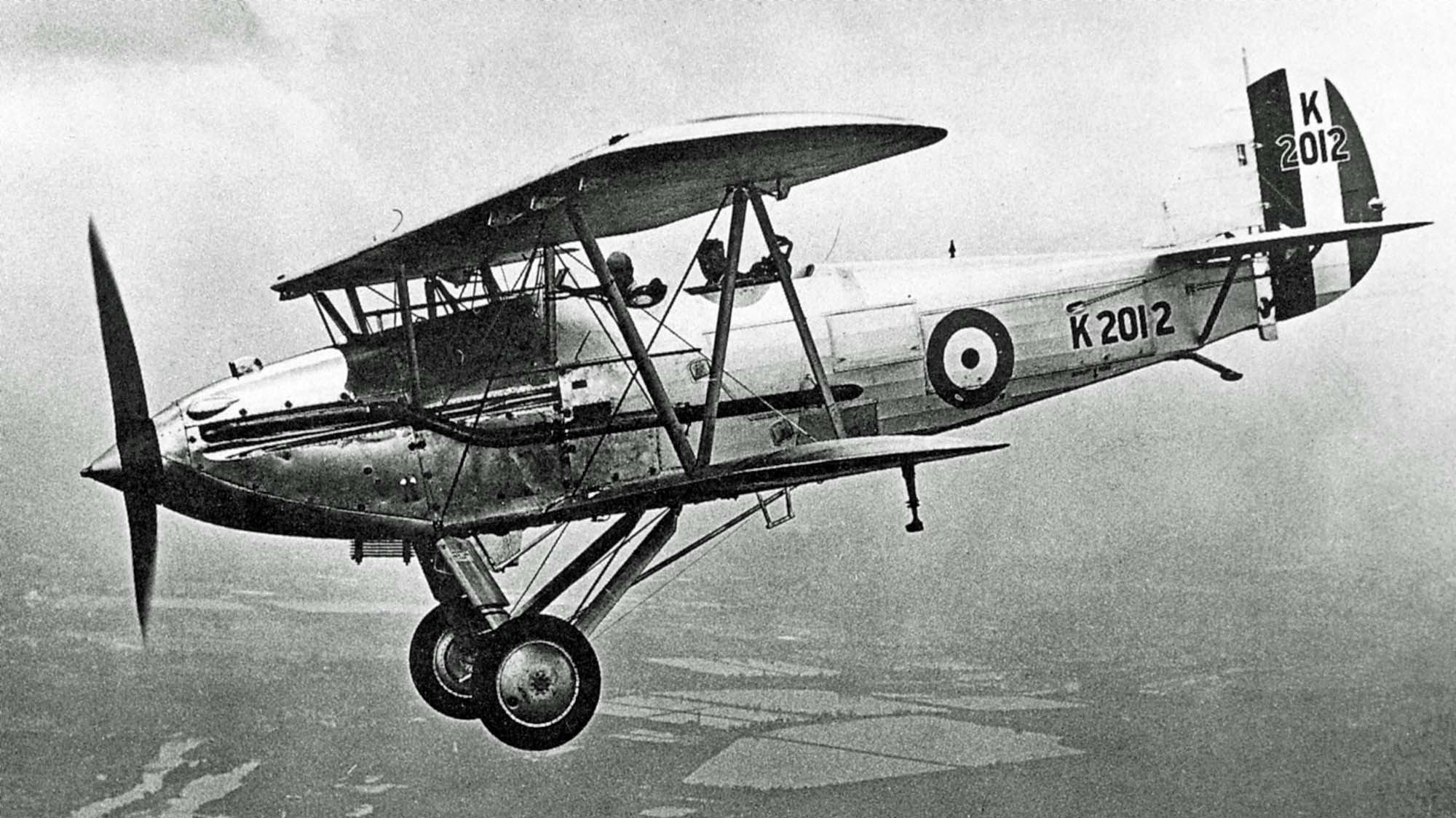
Having demonstrated its capabilities as a close-support aircraft, an early production Hawker Hart was set aside for evaluation in the army co-operation role in mid-1931. A simple adaption of the Hart design, the first production Audax was flown on 29th December 1931 and early Audaxes were easily distinguishable from Harts in having lengthened exhaust manifolds to prevent glare from obstructing the pilots’ view while flying near the ground. An order placed in 1933 included a special version for service in India and Wapiti-equipped R.A.F. squadrons were given the Audax for N.W.F.P. operations. The Audax (India) was powered by a 530 h.p. Rolls Royce Kestrel 1B engine and had a message pick-up hook mounted on the undercarriage spreader bar.
| Country of origin | United Kingdom |
| Armament | One fixed forward-firing Vickers gun on port side of nose and one Lewis gun on rear cockpit mounting. Racks for four 20 lb. (9 kg) practice bombs or two 112 lb. (51 kg) containers under wings. |
| Performance | Max. speed 170 m.p.h. (274 km/hr) |
| Climb to 10,000 ft. (3050 m.) in 8.65 min. | |
| Service Ceiling 21,500 ft (6,550 m.) | |
| Endurance 3 hours 30 mins. | |
| Weights | Empty 2,938 lb. (1,335 kg.) |
| Loaded 4,386 lb. (1,990 kg.) | |
| Dimensions | Span 37 ft. 3 in (11.35 m.) |
| Length 29 ft. 7 in. (9.0 m.) | |
| Height 10 ft. 5 in. (3.20 m.) | |
| Wing area 348 sq. ft. (32.32 sq. m.) |