
English Electric Canberra Mks. B.(I).58, P.R. 57, T.54, B.66, B.12, P.R.67
Negotiations with Britain for the Canberra tactical jet bomber as a replacement for the obsolete B-24 Liberator began in 1954 and continued through till 1956. Although reportedly offered the Ilyushin 11-28 at far less rates, the decision to equip the I.A.F. with the preferred Canberra was reached “in principle” on 1st April 1956 although the official contract was signed with the English Electric Co. Ltd. in January 1957 after protracted negotiations. The order, worth over £20 million including spares, was for fifty four Mk. B.(I)58 interdictor bombers, six Mk.T.54 trainers and eight Mk.P.R.57 high altitude reconnaissance aircraft. The aircraft were built at the Preston, Lancs, factory of English Electric and I.A.F. ground staff received training at the Company’s technical school at Samlesbury, near Preston and with Rolls Royce, makers of the Avon engines. I.A.F. aircrew were assigned to training courses with R.A.F. Canberra units and by May 1957, began ferrying the bombers to India. The Jet Bomber Conversion Unit, with the Canberra T.54s, was established at Agra to provide aircrew for the three formations (Nos. 5, 16 and 35 Squadrons) converting to the B.(I)58. Later in the year, No. 106 Squadron was equipped with the P.R.57. A” supplementary order for twelve more B.(I)58s was placed in September 1957 and additional aircraft, mostly re-furbished ex-R A.F. and R.N.Z.A.F. marks, obtained in 1961-62, 1966-67, and 1970-71 took the total number in I A.F. service to well over one hundred comprising 5 new and 6 refurbished Mk.T.54s, 71 new B.(I) Mk.58s, 10 new P.R. Mk.57s, 10 refurbished B.Mk.66s, 10 B.Mk.12s and some P.R. Mk 67s.
The establishment of Canberra-equipped bomber squadrons meant a major increase in the long range strike potential of the Indian Air Force but it was the strategic reconnaissance unit that gave the arm its “wide eyes”. In the normal run of continuation training, P R.57 missions entailed flights to all corners of the country, carrying vertical and near-vertical cameras for high-altitude photo reconnaissance as also developing techniques to take oblique shots at comparatively low levels.
Six Canberra B.(I)58s of No. 5 Squadron served under UNO colours in support of U.N. forces in the Congo, leaving Agra on October 9th 1961 for Ndjili airport, Leopoldville via Jamnagar and Nairobi. The Canberras first operated in earnest on December 6th rocketing the Katangan airbase at Kolwazi, destroying 4 aircraft, the fuel store, control tower, also damaging a bridge at Lufira, Jadotville and strafing gendarmerie troop trains and convoys. In the following two weeks the Canberras, based at Kamina, provided close support for U.N. troops in the battle for Elizabethville, flew tactical reconnaissance missions besides escorting U.S.A.F. transports flying in reinforcements.
Two Canberra squadrons from Poona were included in the order-of-battle for “Operation Vijay”. On the morning of 18th December 1961, twelve Canberras of No.35 Squadron, escorted by four Hunters, dropped 1000 lb. bombs on Dabolim airports’ runways and this was followed by a! second wave of eight Canberras of No.16 Squadron at 1120 hours. No further Canberra-employment was necessary, the Portuguese forces laying down arms virtually without a fight.
It was in September 1965 that the Canberra force were required to take the offensive in earnest, deep into hostile territory. On the night of 6th September 1965 Canberras raided the major P.A.F. air bases at Sargodha and Chaklala and from then on till the ceasefire on September 22nd, the Canberras flew 200 counter air sorties against these and other Pakistani airbases including those at Akwal, Peshawar, Kohat, Chak Jhumra and Risalwala. Canberra interdiction missions roved over enemy territory against lines of communication, stores and dumps and troop concentrations especially north-west of Pasrur, losing in the effort one Canberra, that to an air-to-air missile on the 21st September. On the 22nd, Canberras attacked and destroyed by rockets the vital radar installation at Badin, in Sind. During the 3-weeks of conflict, Mk.T.54s of the JBCU also participated in offensive sorties.
In December 1971 the Canberra bombers were once more spearhead of the I.A.F.’s strike force. The Squadrons, pivoting their attention from East to West and back, were under the operational control of the Central Air Command. During the liberation of Bangladesh, Canberras were immediately involved in saturation bombing of enemy defence fortifications in the Jessore sector to speed the advance of II Corps, and also in the neutralisation of P.A.F. bases. In the West a force of eight Canberras, flying lo lo over the sea, raided Masroor airbase, dumps and strategic installations near Karachi on the night of 4th/5th December and again the next night, Canberra reconnaissance missions later reporting “the biggest blaze ever seen in South Asia”. All major P.A.F. bases, including Sargodha, were attacked as were railway marshalling yards especially in the Montgomery-Raiwind area and troop and armoured vehicle concentrations. On the 5th December, Canberras made low level attacks flying through the valleys and skimming ridges to disperse Pakistani forces attempting to assault Poonch and the Haji Pir pass area received considerable Canberra attention. During their prolonged operations by day and night, the I.A.F. Canberras dropped ordnance ranging from the 4000 lb. (1816 kg.) “block buster” bombs to “anti-tyre” steel tripods (on Mianwali runway). Between 0400 and 0600 hours on 11th December, Canberras dropped 36,000 lbs. (16,344 kg.) of high explosive on enemy concentrations, artillery emplacements and tank harbours near Burejal, across the Mun-nawar Tawi in Chhamb, with great effect.
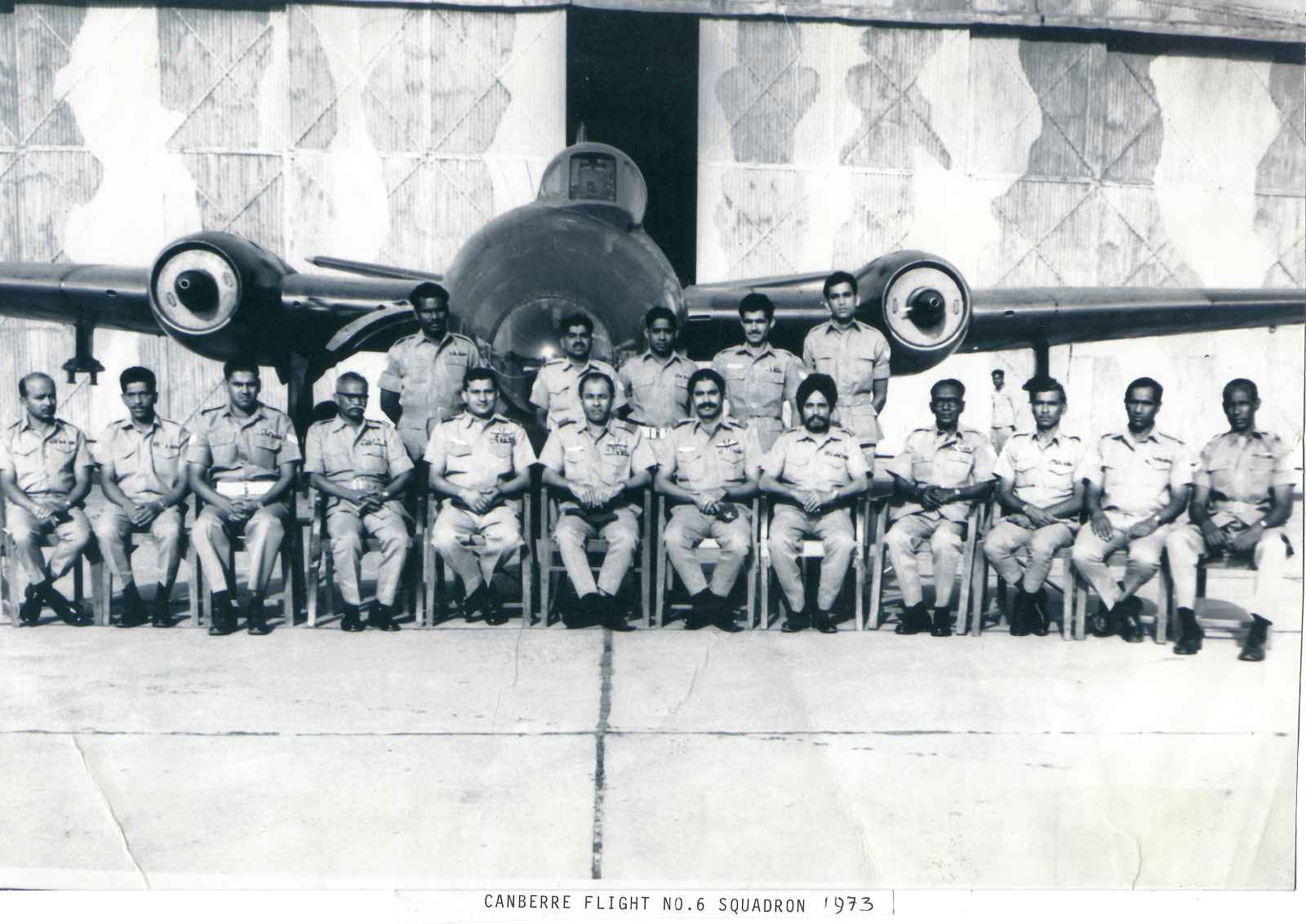
Since the early sixties, major repairs and maintenance facilities for the Canberras have been established at HAL’s Overhaul division at Bangalore and some extraordinary results achieved. A few Canberras faced with stress and fatigue of the centre spar and categorised as beyond economic repair (Cat.E) were made flightworthy again. Attrition has also been made up by fresh purchases and a flight of Canberras earmarked for the anti-ship-ping strike role, providing teeth to No. 6 M.R. Squadron.
After sixteen years of front line service, it is still difficult to identify a replacement for the Canberra.
Notes :
Development of the light tactical jet bomber that was to crystalise as the Canberra began in 1944 and Britains first essay in the jet bomber field flew on May 13th 1949. The Canberra started out as a high performance light bomber but in the second phase of its operational life-cycle, a closer appraisal of its stronger points led to its adoption for roles in which it could be used to best advantage, the emphasis being on tactical use at night. Thus the B.(08 was fitted out for highly specialised night low-level intruder task, the P.R.7 in the high level reconnaissance field, the T.4 being used for conversion and instrument flying-training.
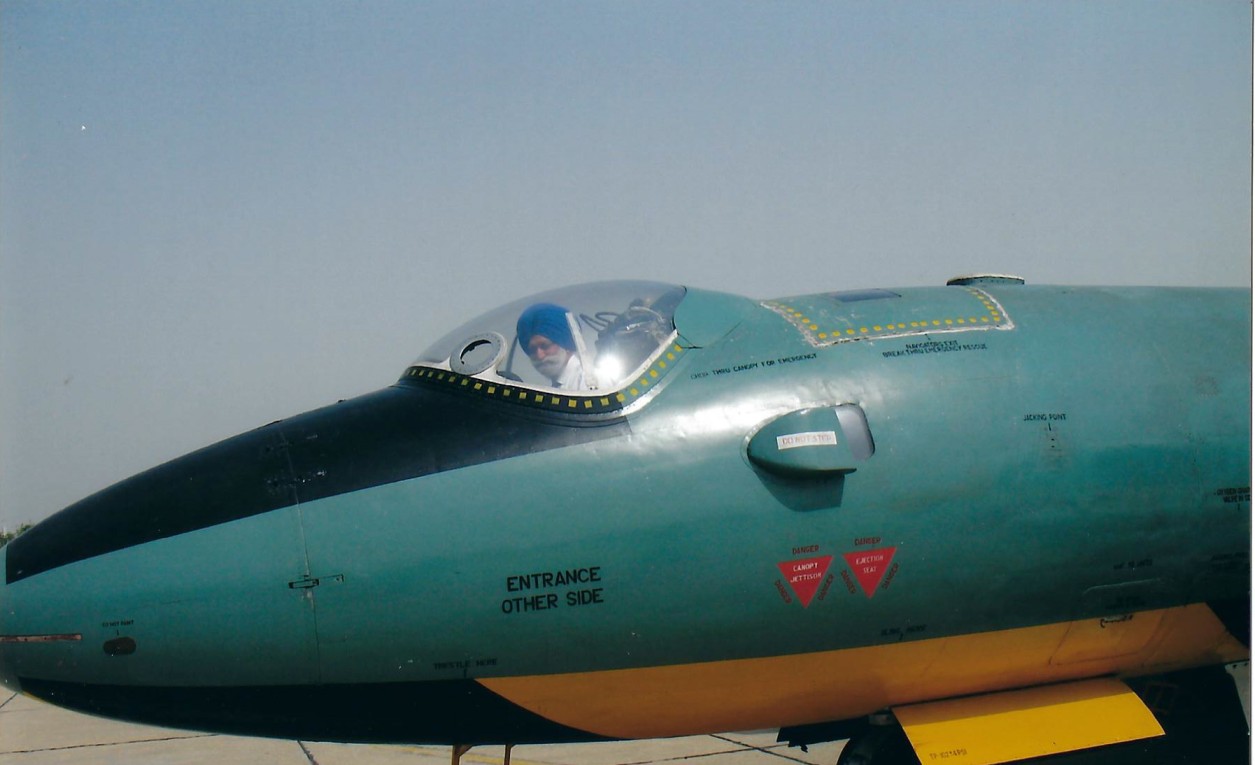
Powered by two Rolls Royce Avon 109 turbojets, the Mk. B.(I)58 incorporated a major redesign in the shape of a new two-seat forward fuselage in which the pilot was seated to port beneath a fighter-type canopy-with the navigator to the starboard and close to the aircraft nose. The Mk.P.R.57 is fitted with seven cameras. The U.S. Martin B-57 was in its original form patterned closely on the Canberra.
| Country of origin | United Kingdom |
| Performance | Max. speed 580 m.p.h. (933 km./hr.) at 30,000 ft. (9,143 m.) (Mach 0.83) |
| Initial climb rate 3,400 ft./min. (1,036 m./min) | |
| Max. operational altitude 48,000 feet (14,630 m.) | |
| Range (interdictor role) 800 miles (1,287 km.) | |
| Armament | (Interdictor) 4 x 20 m.m. Hispano cannon |
| pack and sixteen 4.5" flares or 3 x 1000 lb. | |
| bombs internally plus 2 x 1000 lb. bombs. | |
| (Bomber) 6 x 1000 lb., one 4000 lb. and 2 x 1000 lb. or 8 x 500 lb. bombs internally, plus 2 x 1000 lb. bombs externally. | |
| Weights | Empty 23,173 lb. (10,520 kg.) |
| Max. loaded 56,250 lb. (25,540 kg.) | |
| Dimensions | Span 63 ft. 11 ½ in. (19.49 m.) |
| Length 65 ft. 6 in. (19.96 m.) | |
| Height 15 ft. 7 in. (4.75 m.) | |
| Wing area 960 sq. ft. (89.19 sq. m.) |