

De Havilland Vampire F.3, F.B.52, N.F.54, T.55
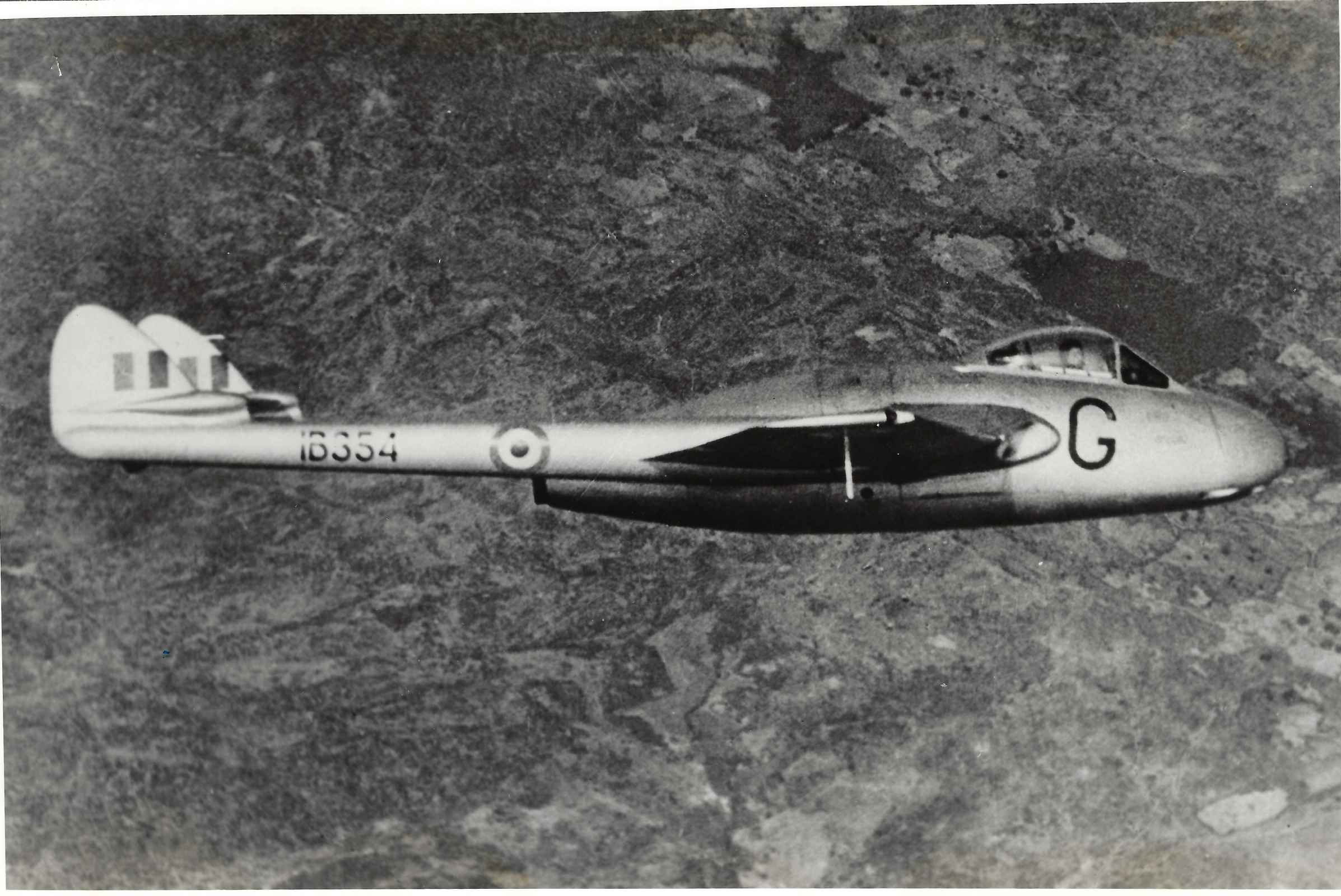
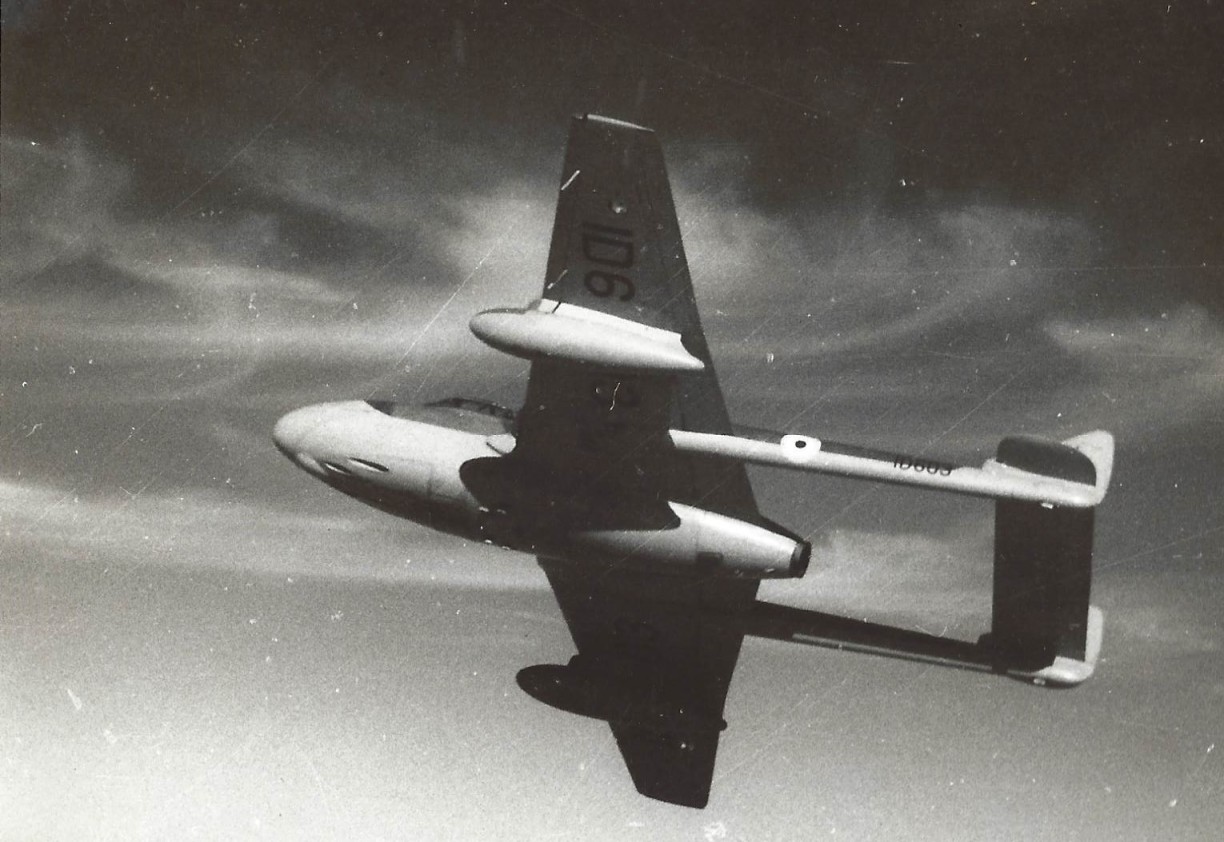
The Royal Indian Air Force was the first air arm in Asia to receive and operate jet fighter aircraft, three Vampire F.3s arriving at Jodhpur, on their way to Palam, on 4th November 1948. Flown across from the U.K., the cocoon-shaped fuselage with characteristic booms was to become a familiar sight throughout the country as increasing numbers of Vampire fighter-bombers, night fighters and two-seat trainers were commissioned.
Through the months of 1948, R.I.A.F. Tempests and Spitfires were strenuously involved with action in Jammu & Kashmir and the force was keen not only to procure additional fighters to make up attrition but also to achieve a veneer of modernity. Rather than invest in the ex-RAF bombers being offered, the British Government was persuaded to release a few jet fighters from the R.A.F.’s inventory and this resulted in procurement of the three Vampires for evaluation and trials. Following successful service trials, the Vampire F.B.52 (refined Mk. 9 with air conditioned cockpit and earmarked for export) was selected as the standard day fighter and five F.B.Mk.52s flown across from the U.K. in December 1950. No. 7 Squadron was earmarked as the first formation to re-equip with jet fighters. Meanwhile, in March 1950, the Government of India entered into a licence agreement with de Havilland’s which covered the eventual manufacture of a total of 281 Vampire F.B.52s, of which the first 34 were put together from imported major assemblies. The first HAL-built Vampire flew on 21st February 1952 and a number of piston-engined fighter squadrons were re-equipped with the type, No. 1 being re-formed in February 1953. The Vampire T.55 (export model T.11) was also selected with a number imported and HAL delivering 60 Vampire T.55s, including ten assembled from imported material, the last HAL-built Vampire being handed over to the Indian Air Force in December 1960. 17 Vampire N.F.54s (export model N.F.10) were received in May 1953 to re-equip No. 10 Squadron at Palam in the night-fighter role and another 12 ex-RAF night fighters were obtained in 1957, No. 37 Squadron being raised on the Vampire N.F.54.
The number of day fighter squadrons operating the Vampire did not exceed more than a half dozen at any one time but the aircraft served as a “stepping stone” for new formations being raised through the fifties. As the Vampire-equipped Nos. 1, 3, 7 & 8 Squadrons converted to the Mystere and Hunter, the Vampires became initial flying equipment of new units such as Nos. 15, 17, 20, 24, 27 & 45 Squadrons. The first Auxiliary Air Force unit to receive Vampires was No. 51 (Delhi) Squadron at Palam on 1st September 1959 but the Chinese-operations in October-November 1962 resulted in the absorption of the Aux. A.F. and Nos. 220, 221 and 222 Squadrons of the regular Air Force were raised on the Vampire F.B.52s. These training squadrons provided jet flying hours in the years 1962-65 as the I.A.F. was expanded to cope with the new strategic situation in the north. The Vampire night fighters were withdrawn late in 1963.
In the late fifties, HAL undertook the conversion of a number of Vampire T 55s to the photo-reconnaissance configuration and two squadrons, Nos. 101 and 108 operated the P.R. Vampire for over a decade. On the 26th April 1965, PR Vampires from Jamnagar covered the length of the Rann of Kutch, flying at less than 100 feet obtaining, near Bier Bet, conclusive evidence that U.S. gifted M48-A2 Patton tanks of the Pak. Army were in action against India. In November 1962, some six Vampire T.1 1s were purchased from Indonesia, the A.U.R.I. having then standardised on Soviet aircraft; for many years, through to the seventies, IAF fighter squadrons had one or two Vampire T.55s on strength, employed as “hack” aircraft.
Vampires fired their guns in anger during the liberation of Diu, aircraft from the Pilot Attack Instructor’s course operating against Portuguese positions in December. 1961. Eight Vampire F.B.52s of No. 45 Squadron, operating from Sambre (near Belgaum), provided close support to the troops of 17th Infantry Division in the opening phases of “Operation Vijay” and three Vampire T(PR)55s of No. 108 Squadron were used for Photo and Tactical Reconnaissance. During the police action, No. 37 Squadron with its Vampire N.F.54s were deployed for night fighter duties over Poona and Bombay.
Vampires were also usefully employed in the counter insurgency role in the Naga hills but the aircraft were obsolescent when they were pitched into battle in 1965. On the 1st September 1965, Vampire F.B.52s of No. 45 Squadron flew twelve sorties at 5.45 p.m. in response to an urgent request for air strikes against Pakistani armoured forces in Chhamb. Supplemented by Mystere IVAs, the Vampires were first in action against enemy vehicles but lost four aircraft to enemy Sabres and anti-aircraft fire. After the war, in 1966, the Vampires were finally supplanted, by such types as the Gnat, MiG-21, HF-24 and Su-7.
The venerable Vampire was, however, to operate in earnest once more and this time the role was carefully alloted, taking maximum advantage of the aircraft’s simplicity, ease of operation/maintenance and manoeuvrability. A detachment of four Vampire F.B.52s from a training unit was based at Srinagar during the December 1971 conflict with Pakistan and operated at low level in the difficult mountainous terrain of Pakistan’s “underbelly”. The Vampires systematically reduced defence strong points with rockets and cannon, thereby contributing to the successful advance of Indian troops in the Kargil, Tithwal, Poonch and Uri sectors. Enemy picquets in Kargil and the Lipa valley were destroyed by the relatively ancient 90-1b. r.p.s while the airfield at Skardu was bombed and enemy vehicles, gun positions & POL/supply dumps strafed, all without loss to the Vampire unit. Vampire trainer-fighters, were active over the Punjab by night, their nocturnal inter-diction activity thus keeping the enemy engaged round the clock.
Vampire F.B.52s, alongside the T.55 trainers, however continued in the training function at the Fighter Training Wing at Hakimpet, the F.I.S. Tambaram and A.T.W. Jamnagar. After basic flying training on Harvards, future fighter/bomber pilots have been required to complete 120 hours on the Vampire at the Jet Training Wing, Hakimpet (now F.T.W.) prior to joining operational units and hundreds of I.A.F., I.N. and foreign fighter pilots had their first jet experience on the “tolerant” Vampire.
Notes :
Initially known as the Spider-Crab, Ole first of three D.H.100 Vampire prototypes flew on September 26th 1943 and appeared just too late to see service during the Second world war. The novel feature of the aircraft was its twin-boom layout which kept the jet pipe as short as possible to minimise power losses and the turbojet installed in the rear of the short central fuselage nacelle drawing air from wing root intakes. With monocoque nacelle made of balsa sandwiched between thin plywood skins, the Vampire F.3 first flew in November 1946 and was followed by the F.B.Mk. 5, a ground attack variant, the F.B 9 being a tropicalised refinement with an air-conditioned cockpit and powered by a 3,350 lb s.t. (1,520 kg.) Goblin DGn3. The export version was designated the F.B.Mk.52. The D.H.113 Vampire N.F.Mk.10 night fighter (export version designated N.F.54) used the wings and tail booms of the day fighter but the nacelle was widened to accommodate a second seat for a radar operator/navigator and lengthened to carry an American AI Mk.X interception radar. The D.H.115 Vampire T.11 (export version designated the T.55) first flew on November 15th 1950 and had all essential cockpit instruments and controls duplicated but was otherwise basically similar to the N.F.10, power being provided by a 3,500 lb.s.t. (1,590 kg.) Goblin 35 turbojet. Vampire production totalled about 2000 aircraft, and of these nearly one fourth were accounted for by the Indian Air Force.
| Country of origin | United Kingdom |
| Armament | Four Hispano Mk.5 20 m.m. cannon, eight 90-1b. r.p.s. or two 1000 lb. (454 kg ) bombs. |
| Performance | Max. speed 548 m.p.h. (882 km./hr.) / Initial climb rate 4,800 ft./min. (1,463 m./min.) |
| Operational ceiling 45,000 ft. (13,720 m.) / Combat range 1,220 miles (1,963 km.) | |
| Weights | Empty 7,283 lb. (3,307 kg.) |
| Max. take off weight 12,390 lb. (5,624 kg.) | |
| Dimentions | Span 38 ft. 0 in. (11.58 m.) |
| Length 30 ft. 9 in. (9.39 in.) | |
| Height 8 ft. 10 in. (2.70 m ) | |
| Wing area 262 sq. ft. (24.34 sq. m.) |