
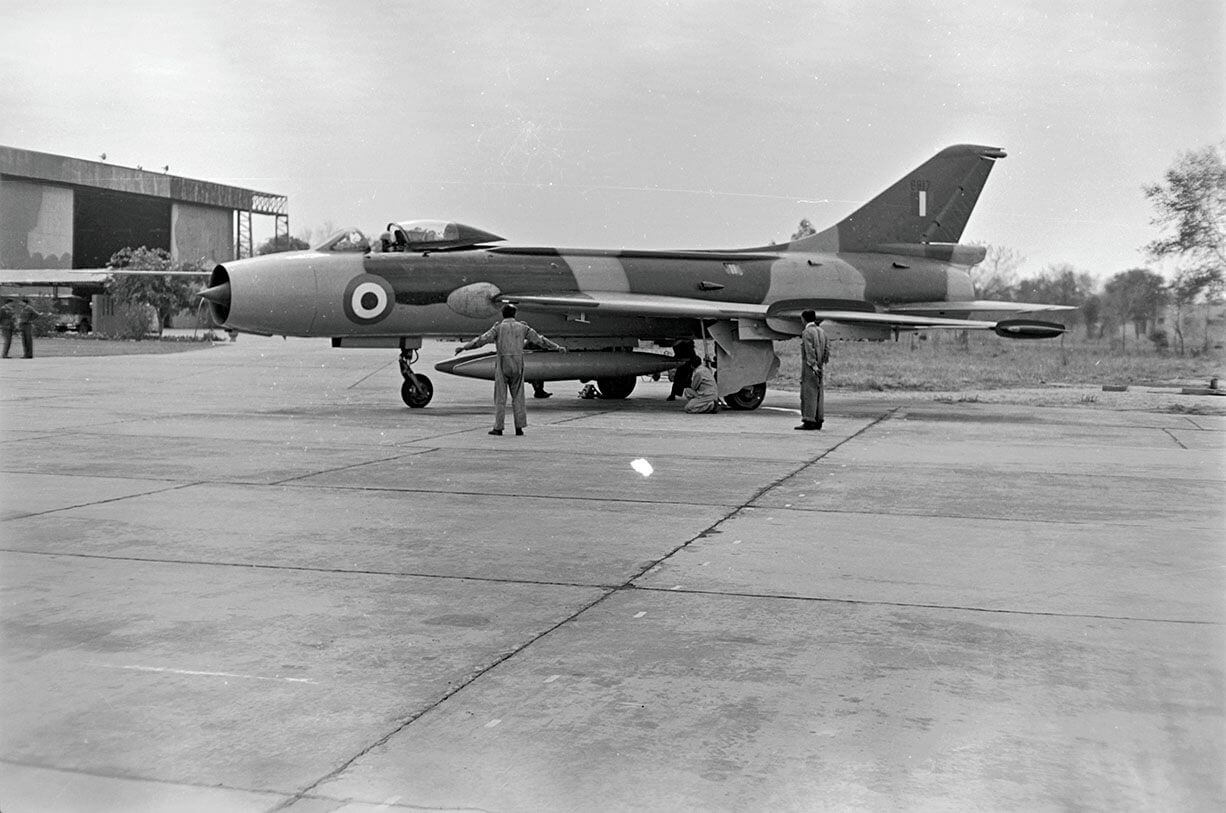


After an aeon, shortly after dawn on December 4th 1971, Maruts, the spirits of tempest and thunder in Indian mythology, struck again but their weapons comprised contemporary 30 m.m. cannon, 68 m.m. rockets and 1000 lb. bombs. These Maruts were no figments of folk-lore but progeny of the Bangalore assembly line of HAL: India’s first indigenous combat aircraft being blooded in action and forming an integral part of the Indian Air Force’s strike force of the seventies.
Two pre-production HAL HF-24s were handed over to the I.A.F. at Bangalore on 10th May 1964 and taken on by the Aircraft and Armament Testing Unit at Kanpur, an establishment evaluating aircraft and their systems. Joined by increasing numbers of pre-production aircraft, the Marut’s underwent service and weapon-systems trials for nearly three years before the re-formation of No. 10 Squadron, the first unit to be equipped with the HF-24 Mk.1 on 1st April 1967; a second unit, No. 220 Squadron, was converted to the production model Marut on 1st April 1969 at
Poona. The role assigned to the Marut formations was ground attack for which the aircraft, possessing formidable armament, was eminently suitable. While fulfilment of the original multi- role envisaged for the definitive Marut must perforce await the availability of suitable powerplants, the Mark 1 has lived up to the low-level ground attack profile which is the aircraft’s intended scene. In the acid test of war, the Maruts were distinguished in terms of serviceability,flew well and hit hard.
Operating from airbases in the Thar desert of Rajasthan and in their element flying at deck level in hot and dry conditions, the first of 300 offensive sorties flown by Maruts during the December,1971 conflict were counter air operations against Pakistani air bases in Sind. The targets were upto 200 miles (320 km.) inside hostile territory and the 1000 lb. (454 kg.) bombs cratered the runways at the PAF bases but no attempt was made to intercept the Maruts which encountered only light anti-aircraft fire. Later in the day, Maruts flew ground attack sorties against camp “Ghazi” a heavily defended area within which a series of bunkers were destroyed by rockets, this “softening up” proving of invaluable assistance to the Indian 11th Infantry Division when it moved forward towards Naya Chor on the following night. Columns of Pak.
vehicles were strafed and rocketed by Maruts on 5 and 6 December at Longewala, complementing the tremendous effort made by Hunters from Jaisalmer and further south, opposite Sundra, the Maruts attacked and dispersed a oncentration of Pak. troops and vehicles, their 68 m.m. SNEB rockets proving highly effective against AFVs. Diurnal interdiction
missions were flown against the Pakistani transportation system, the Maruts concentrating on the railway line from Rohri to Khanpur and the marshalling yards and rail junction at Mirpur Khas were heavily attacked by Maruts on 7 and 8 December. Although escorted on occasions by MiG- 21s, the Maruts could hold their own against enemy fighters at medium heights and on 7 December a Marut shot down a F-86F Sabre south east of Chor. No Maruts were shot down or
damaged by enemy aircraft but they had to run the gauntlet of fairly intense anti-aircraft fire and the fact that damaged Maruts could be flown nearly a thousand miles to Bangalore for “pucca” repairs after the war is testimony enough to this aircraft’s robustness while remaining, aerodynamically, one of the cleanest fighters extant.
The Mark 1 is powered by a pair of licence-built HAL/Rolls Royce Bristol Orpheus 703 turbojets each rated at 4850 lb.s.t. (2202 kg.) and the twin engine reliability has been a great safety factor. Several Maruts regained their base after one engine had been lost to ground fire; no missions flown during the two weeks of combat were aborted as a result of any malfunction of the HF-24’s powerplant, armament or any system and the squadrons enjoyed an extremely high rate of serviceability.
The first phase order for the HF-24 Mk.1 covered some four score aircraft with the I.A.F. to also receive about forty Mk.1T tandem-seating operational trainers. Retaining all features and dimensions of the Mark 1, the trainer version differs only in the removal of the internally housed rocket pack in which place the rear seat is installed. The Mk.1T has dual controls and a wide selection of systems which enable it to be used for several advance roles including instrument and armament training. Production of the Mk.1 is continuing, an additional 50 aircraft being
ordered by the IAF to make up attrition as also to form an additional ground-attack squadron with the type.
Notes :
An Air Staff Requirement formulated in the mid fifties specified an advanced aircraft for both high altitude interception and ground attack duties. In pursuance of the national objective of attaining self reliance in the design and production of combat aircraft, it was also directed that this aircraft be developed within the country and Hindustan Air-craft Ltd., as the present Bangalore division of HAL was then known, was given the task of handling the project. Dr. Kurt Tank, of the Luftwaffe’s FW 190 fame, established and headed the design team, both German and Indian, that gave the A. S.R. shape and substance. Simultaneously building up the infrastructure as work progressed, detailed design work commenced in June 1957 and trials were initiated with a full scale wooden glider on 1st April 1959. Assembly of the first prototype (HF 001) began in April 1960 and taxi trials commenced on 11th March 1961. First flight of the prototype BR 462 was on 17th June 1961. Flight development processes were uneventful, the two prototypes being joined by 18 pre-production HF-24 Mk. ls. The first series-production
Mark 1 aircraft flew on 15th November 1967 and first phase orders called for some 62 production Maruts. Development of the Mark IT trainer was the responsibility of an all-Indian team under S.C. Das from 1967, the prototype Mk. iT (BD 888) first flying on April 30th 1970.
The first Marut with reheat, designated Mk,1A, was powered by a G.T.R.E.-designed after burning system providing a 27% boost; other prototypes, designated Mk.1R, have completed flight trials, and the Mark II would be the production model of the reheat version, four pre-production examples having been considered. The Marut (HF 020) designated as HF-24 Mk.1BX was provided to the UAR for trials with the E-300 engine. The supersonic, multi-role, Mark III awaits the availability of a suitable powerplant and various alternates have been considered including a single engine of superior rating developing upto 19,500 lb.s.t. (8,850 kg.) or two engines similar to those powering the European MRCA advanced aircraft.
The second phase of the Marut development could be considered as having begun from 1973 with foreign collaboration sought in the re-design and re-engining of the basic air-craft for which an “exciting” future is envisaged. It is hoped that the Mark III (also labelled the HF 73) would be available for squadron service by the late seventies and provide the IAF with its supersonic strike force of the eighties.
Data :
Country of origin : India Armament : Four 30 m.m. Aden Mk.II cannon with 130 r p.g.
Internally-housed Matra Type 103 launcher with 50 x 68 m.m.
rockets; four 1000-1b. (454 kg.) bombs, Type 116 SNEB rocket pods;
napalm canisters or T.10 rockets or 100-Imp. gallon (455 litre) auxiliary fuel tanks.
Performance : Max. speed Mach 1.02 at 40,000 ft. (12,190 m.)
705 m.p.h. (1,135 km./hr.) at SL
Time to 40,000 feet (12,190 m.) 7 min.
Service ceiling 46,000 feet (14,030 m.)
Combat radius 400 miles (644 km.)
Min. flying speed, clean, 152 m.p.h. (245 km./hr.)
Weights : Empty 13,658 lb. (6,197 kg.)
AUW 19,734 lb. (8,954 kg.)
Fuel Capacity : 654 Imp. gallons (2,970 litres) (internal)
Dimensions : Span 29 ft. 6 ¼ in. (8.99 m.)
Length 52 ft. 0 ¾ in. (15.87 m.)
Height 11 ft. 9 ¾ in. (3.60 m.)
Wing area 273.9 sq. ft. (20.21 sq. m.)

| Album: | RIAT 2016 |
| Exact Type: | Beech AT-6A Wolverine |
| Generic Type: | Beech AT-6A Wolverine |
| Generic Type: | Beech T-6 Texan II |
| Operator: | Textron |
| Markings of Operator: | Beechcraft |
| Serial/Reg'n.: | N630LA |
| Code: | |
| MSN: | |
| ocation: | Fairford |
| Region: | England |
| Country: | United Kingdom |
| Date: | 10 July 2016 |
| Event: | RIAT 2016 |