In the mid-fifties, even while I.A.F. fighter squadrons continued to operate the subsonic Vampire F.B.52 and Ouragan, the airline Air India International was ordering Boeing 707s which had a higher speed at altitude than the Air Force fighters. Far more significant, the Pakistan Air Force was receiving its first F-86F Sabres, three squadrons becoming operational on the type during the course of 1956.
A number of transonic fighter-types had been evaluated by I.A.F. test pilot teams but as the British Government would only confirm availability of the Hunter F.Mk.4 and not the F.Mk.6 as was desired, the Indian Government placed orders with France in 1956 for the Mystere IVAs, successor to the Ouragan and from the same, stable. It was on the Mystere IVA that Indian test pilots in France first broke through the “sound barrier”. Nominated Ouragan-pilots and ground crew received conversion training on the Mystere IVA in France and this team was formed into No. 1 Squadron as the aircraft were being ferried to India. (No. 1 Squadron, then flying Vampires was re-designated as No. 27 Squadron). The first 32 aircraft were flown in from France in groups but the bulk of the Mystere IVAs were delivered, along with a second batch of Ouragans, suitably cocooned, by a French naval carrier at Bombay on 25th April 1957. The last ten Mysteres of the total order for 110 left the Dassault factory at Merignac on November 26th 1958, the final aircraft (IA 1334) being flown to India in that batch.
The Ouragan-operating Nos. 8 and 3 Squadrons converted to the Mystere IVA and were for some years primarily committed to the air defence, with a secondary fighter-bomber, role in Eastern India and based at Kalaikunda.
In the aftermath of the conflict with China and the altered strategic situation in South Asia, a considerable expansion of the Air Force was undertaken, part of the defence plan being the raising of new Mystere IVA formations. Accordingly, Nos.31 and 32 Squadrons were formed on the type and equipped with Mysteres held at storage depots in Southern India.
4 Mystere IVAs of No. 1 Squadron were detached to Santa Cruz in December 1961 for anti-shipping and fighter sweeps during the action against Portuguese Colonies. Mystere IVAs later saw extensive service in the close support role during the September 1965 conflict with Pakistan. At dusk on 1st September 1965, in response to the request for air support by 191 Brigade facing a major Pak. armoured thrust on Akhnur in Chhamb, Mysteres of Nos.3 and 31 Squadrons flew sixteen sorties within forty five minutes in the heels of Vampires. Operating from Pathankot, the aircraft, in flights of four, destroyed 14 Patton tanks and some 30 ‘B’ vehicles with rockets and cannon, the Mysteres making upto as many as six runs over the battlefield. To quote, “Our boys were in like a flash and in no time the whole place was ablaze with burning tanks and vehicles the enemy will never forget the Mystere”. The Mysteres predominated in air activity over Chhamb, tank-hunting and destruction of convoys and concentrations continuing through the next few days, the aircraft possessing formidable firepower in the shape of 30 m.m. cannon, 55 rockets in the belly, 68 m.m. underwing rocket pods or T.10 high velocity r.p.s. As enemy fighters were expected, the low flying Mysteres were normally escorted by a flight of Gnats which often led to conclusive air combat with Sabres. On the 6th September, the Indian XI Corps thrust into Pakistan and Mysteres were involved in counter air strikes the same morning while No.1 Squadron roved on interdiction missions, destroying an oil tanker train near Gujranwala. On the 7th, fourteen Mystere sorties were flown just after dawn against the major airbase of Sargodha, the tree-top height attack by Nos.1 and 8 Squadrons by day entailing considerable risk as the enemy airbase complex was heavily defended by guns and fighters. On the 8th September, the Indian I Corps spearheaded by the 1st Armoured Division opened the Sialkot front and Mysteres, with Gnat escorts, were much in evidence mounting ground strike sorties against enemy strong points, dumps and communication centres, dispersing armoured concentrations specially around Pasrur and Chawinda.
The Mystere IVA certainly earned its pay in the ground-attack role in 1965 but the type had limited capabilities as a fighter, its power/weight ratio being poor and handling characteristics and manoeuvrability leaving much to be desired. In 1966, No.1 Squadron re-equipped with the MiG-21FL, followed by No. 8 Squadron, but some sixteen Mysteres were issued for the Armament Training Wing in 1967-68, their duties including the towing of target-sleeves secured to airbrakes. A few years later, No.32 Squadron converted to the Su-7BMK, the remaining units being re-designated as Fighter-Reconnaissance Squadrons following the fitment of three oblique and forward facing cameras in a few Mysteres.
Before being phased out of the I.A.F.s’ combat inventory however, the Mysteres were to operate in earnest once more. During August 1971 heavy troop movements and concentrations of Pak. armoured forces in offensive order necessitated the Indian contingency plan to be put into effect and accordingly the Mysteres IVAs of Nos. 3 and 31 Squadrons were deployed for defensive action in the Ganganagar-Fazilka. Providing close support to troops in the Foxtrot Sector, more than 300 sorties were flown by day, the Mysteres concentrating on Pak. armour, dumps and lines of communication in the area of Fort Abbas, Bhawalnagar and Haveli. Intelligence had reported nearly 300 tanks of the Pak. 1st Armoured Division concentrating between Sulemanki, Haveli and Amruka and Mysteres, flying lo lo, were subjected to heavy anti-aircraft fire as they sought to destroy the armoured threat, many aircraft being recovered with extensive damage in the wings and fuselage. Opposite the 67 Infantry Brigade in Fazilka, Mysteres continuously attacked the wooded area around Haveli and succeeded in immobilising Pak. armour and shooting up convoys and rail tankers.
The Mystere IVA had confirmed its reputation ‘as a first rate ground attack aircraft and was thus retained in this role inspite of spares stringency. However, after the war early in 1972, No.3 Squadron phased out its Mysteres in favour of the MiG-21FL while No.31 Squadron retained the Mystere IVA into 1973.
Notes :
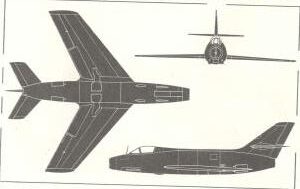
The first Mystere resembled the elder Ouragan entirely except that its wings were swept at an angle of 30°. Between 1951 and 1953, prototypes of the Mystere I, IIA, IIB and IIC flew while the Mystere IV (originally called the Super Mystere) made its first flight on 28 September 1952. The production model, the IVA, become the subject of off-shore procurement orders, a total of 483 being built, mostly for France but also for India and Israel. The robust single seat fighter-bomber was powered by one Hispano-Suiza Verdon 350 turbojet rated at 7,710 lb. s.t. (3,500 kg.) and housed a ranging radar antenna in the bifurcating wall in the intake duct.
| Country of origin | France |
| Armament | Two 30 m.m. DEFA cannon with 150 r.p.g. 50 x 68 m.m. internal rocket pack |
| Two x 68 m.m. pods each with 19 rockets or Two x 1000 lb. (454 kg.) bombs or clusters of T.10 rockets | |
| Performance | Max. speed 696 m.p.h. (1119 km.ihr.) at SL (Mach 0.91) |
| 615 m.p.h. (990 km./hr.) at 36,000 ft. (Mach 0.94) | |
| Range (clean) 570 miles (917 km.) | |
| Initial climb rate 8,860 ft./min. (2,700 m./min.) | |
| Service ceiling 45,000 ft. (7,240 m.) | |
| Weights | Empty 12,950 lb. (5,880 kg.) |
| Max. loaded 20,050 lb. (9,103 kg.) | |
| Dimensions | Span 36 ft. 5 ¾ in. (11.12 m.) |
| Length 42 ft. 1 ¾ in. (12.84 m.) | |
| Height 15 ft. 1 in. (4.60 m.) | |
| Wing area 344.5 sq. ft. (32 sq. m.) |